Removals to Amsterdam
Amsterdam is a demanding city to move into, and the difficulty is architectural. Much of the historic housing stock was built narrow and tall, with staircases that most furniture cannot use, so larger pieces go in through an upper window on a hoist. Getting a vehicle close enough to the door needs permission from the city, applied for well in advance.
Williams & Yates coordinate moves to Amsterdam for private clients, for senior executives relocated by an employer, and for families moving on their own terms. Every move runs through one dedicated coordinator, who stays with you from the first conversation to the last piece set down in the new home.
Why Clients Choose Williams & Yates for Amsterdam
One person runs your move from the first survey to the final walkaround in Amsterdam. That is the same person who applies for the city permits, confirms the window dimensions, chases the customs documentation and books the hoist. Nothing is passed between departments, and you never have to explain your move twice.
Behind them is a crating workshop we own and run ourselves, where cases are built to each piece’s measured dimensions rather than ordered in. That matters more in Amsterdam than in most cities, because a crate going up the outside of a building has to be built for the window it is going through.
We hold FIDI/FAIM accreditation, the international removals industry’s highest standard, and we are BAR members and Which? accredited. At destination we carry every item into the room of your choosing, unwrap it to a clear surface, reassemble the furniture and set crated pieces down. Pets and vehicles are handled as part of the same move.


What Your Tailored Survey Covers
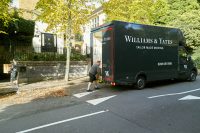
Everything starts with a survey at your home, in person or virtually. A surveyor works through the volume, assesses each item for the care it will need, and records the access at your UK address. We then prepare the inventory on your behalf, and you receive a tailored quote covering the move door to door, alongside your coordinator’s direct line.
The survey is also where the Amsterdam end is settled. Your destination property cannot be surveyed in person the way your own home can, so we assess it remotely and ask specific questions in advance: which window will be used for any hoisted items, how it opens, whether it is single or double glazed, and whether a glazier will need to remove it beforehand.
Arrange a tailored home survey and we will set out what your Amsterdam move involves.
Arrange a Tailored Home SurveyCanal House Access, Hoists and City Permits
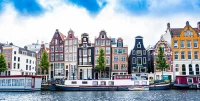
In much of central Amsterdam, hoisting furniture through an upper window is the standard way of getting it into the house. The canal houses were built narrow and steep, and their staircases were never intended to take a wardrobe or a dining table.
The response was the hijsbalk, the gable hook still visible at the top of most canal-house facades. A pulley runs from the beam, and larger items travel up the outside of the building and in through a window. Canal-house windows tend to be unusually generous for that reason, and many can be opened wide or removed entirely.
So window dimensions matter as much as door and stair dimensions, and they need to be established before the vehicle leaves the UK. This is work we know. We have taken items through a window that could not have gone near a staircase, an American-style double wine fridge among them, hoisted on a hired external elevator with the window taken out first.
Getting the vehicle close enough means applying to the city. Reserving the parking bays outside the property is a separate permission from being allowed to bring a vehicle into a street it would not normally enter, and the municipality asks for at least six working days’ notice on both. A removal van over 7.5 tonnes needs a further exemption for the heavy traffic zone, and the quays and bridges along the canals carry their own weight limits. Your coordinator makes those applications and plans the vehicle around the answers.
Where a property carries rijksmonument or gemeentelijk monument status, anything beyond ordinary use of the existing fabric is checked with the municipality first.
Our guide to Amsterdam’s canal houses and what they mean for your move covers the architecture, the hoisting and the permits in full.
Dutch Customs and the Removal Goods Exemption
Your consignment travels by road, either overland through Belgium via LeShuttle or the Dover to Calais ferry, or by direct sea crossing from Harwich to the Hook of Holland. Your coordinator selects the route around your volume, your collection date and the access at the Amsterdam end.
Because the UK now sits outside the EU, your belongings arrive in the Netherlands as goods from a third country. Dutch Customs administer the verhuisboedelvrijstelling, the removal goods exemption for people moving to the Netherlands from outside the EU, which allows used household and personal effects to enter without import duty or VAT. It has to be applied for, and it is not granted automatically.
None of this is paperwork you are expected to navigate alone. We tell you which documents are needed, in what order and by when, then manage the process so nothing reaches the border incomplete. The Netherlands removals page sets out the documentation in full, along with the difference between a shared vehicle and a dedicated one.


-
Fine Art, Antiques and Crated Pieces
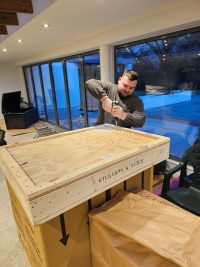
Fine art, sculpture, antiques and mirrors travel in crates built in our own workshop to each piece’s exact dimensions, measured at survey so they are ready on collection day. Crates for international consignments use ISPM 15 compliant timber, and we choose packing materials per piece.
Amsterdam adds a specific consideration here. If a crated piece has to be hoisted, we build the crate with the hoist in mind and confirm the window opening before it is made.
Where a piece is made from a protected species, we handle the CITES documentation. Our fine art removals service and custom crating workshop pages cover the full detail.
-
Corporate and PA-Managed Relocations
An employer-arranged relocation changes the paperwork. The inventory becomes a formal document, itemised and valued in the format your relocation department, employer or insurer requires, and we produce it in that form. Billing can be arranged directly with an employer or a relocation management company.
Many Amsterdam moves are run day to day by a PA or household manager on behalf of the principal. Your coordinator takes instruction from whoever is managing the move and reports back to them at each stage, so the principal is involved only where a decision genuinely needs them.
Amsterdam Neighbourhoods and What They Mean for Access
Three areas account for most of the premium relocations we handle in Amsterdam, and each presents very different access.
The Grachtengordel, the seventeenth-century canal ring, is the most constrained. UNESCO inscribed the canal ring inside the Singelgracht as a World Heritage Site in 2010, and that density of protected, original housing stock is why the stair and hoisting constraints above are the norm here.
Oud-Zuid, immediately south of it, was laid out from the late nineteenth century with wider streets and stately townhouses rather than tightly packed canal houses. Access is generally more forgiving, though individual listed properties within it present the same challenges, so we assess it regardless of postcode.
Amstelveen, further south, is where relocating international families most often land, and in moving terms it means larger, more modern housing and much easier vehicle access. The Jordaan and De Pijp sit within or close to the historic centre, so the access picture there looks much like the canal ring.
Our guide to the best areas to live in Amsterdam covers each in more depth.
Arrange Your Amsterdam Move
Arrange a tailored home survey and you will receive a written quote, a full inventory prepared on your behalf, and the direct line of the coordinator who will run the move from that point on.
For a broader view of the route, the Netherlands removals page and the European removals hub set out how we work across the region.
Arrange a SurveyAmsterdam Move FAQs
-
What does your quotation include?
The quote covers the move door to door: packing, collection, the crossing, customs clearance into the Netherlands, the city permits needed at the Amsterdam end, delivery into the rooms of your choosing and unpacking. Where a hoist, an external elevator or a glazier is needed, that is identified at survey and priced in rather than added later.
-
Is the vehicle dedicated to my move, or shared with other consignments?
Both are available. A dedicated vehicle travels from your door to your destination with nothing else on board, which gives the tightest control over timing. A shared load is more economical where the volume is smaller and the dates are flexible. Your coordinator will talk both through at survey.
-
Who will actually be in my house?
Our own crews, working under your coordinator, who will tell you in advance who is attending and when.
-
Will my furniture need to be hoisted through a window?
In many central Amsterdam properties, yes. Canal-house staircases are too steep and too narrow for most large furniture, which is why the gable hook and external hoist exist. We assess and plan for it at survey stage, including which window will be used and whether it needs to be removed first.
-
Do you handle the Dutch parking and road permits?
Yes, your coordinator applies for them. Reserving the parking bays outside the property and being allowed to bring the vehicle into a restricted street are two separate permissions, the city asks for at least six working days’ notice on both, and a removal van over 7.5 tonnes needs a further exemption for the heavy traffic zone. That lead time is one reason the Amsterdam end is settled at survey rather than close to the date.
-
What if the Amsterdam property is not ready when my belongings arrive?
This is common enough that we plan for it rather than react to it. Your consignment can be held in storage at either end, and your coordinator will sequence the delivery around your registration with the Gemeente and the date the property becomes available.
To book or ask us a question, call us on 0208 081 0188 or get in touch.