0208 081 0188
Contact us
0208 081 0188
Contact us
Press enter to begin your search

Removals to Australia
With over 1.3 million expatriates, this makes Australia one of the most popular destinations for British citizens to move to.
Removals to Australia from the UK are unlike most international moves. Your belongings make one of the longest sea passages a household can take, arrive into a process built around biosecurity, and travel with an inventory written for an Australian officer to read. Williams & Yates manages international removals to Australia for families moving a valued home, art or collections, with one dedicated coordinator running the move from survey to delivery.
If you are heading for a particular city, our pages on removals to Sydney and removals to Melbourne cover the local detail.
How We Manage Your Move to Australia
Every move begins with a survey, in person or virtual, so we can see what is going, what needs special handling and what the access is like at both ends. From then on, you have one dedicated move coordinator as your single point of contact until the last box is unpacked. Your coordinator handles the customs, duty and Australian requirements for you.
On a move to Australia, the inventory carries particular weight. It is the document Australian customs and biosecurity officers read to decide how your consignment is treated, so we complete it for you and describe each item by what it is made from, the detail those officers expect.
Anything fragile or valuable is crated in our in-house workshop, built to specification for the piece it protects. Crates for international consignments use ISPM 15 compliant timber, and our work is backed by FIDI/FAIM, BAR, IAM and Which? accreditation.
Many of our moves to Australia are run day to day by a PA or household manager, and we work alongside them throughout. On larger moves, a project manager can fly out to oversee the crews and the unpack jointly with the PA. One move can also span several collection addresses, such as a main home and a second property, consolidated into one consignment.
Storage is raised at the survey as part of the plan, not as a last-minute fix. We offer secure storage in the UK, and we have storage at your destination for when your new home is not quite ready.
At the other end, you choose between a debris clear unpack, with everything placed on clear surfaces for you to put away, or a full white-glove unpack, with every box emptied and the beds dressed ready to sleep in.
When you are ready, arrange a tailored survey or call us on 0208 081 0188.
Talk to us-
-
Groupage, Part Load or a Full Container: How Your Belongings Travel
Groupage, part load and shared container are three names for the same service. Your belongings travel in a container shared with other households’ goods, and you use only the space your consignment needs. A full container load is reserved for your belongings alone.
Shared container (groupage, part load) Full container load Best suited to A partial move or a selection of pieces A whole-house move Container use Shared with other consignments Yours alone Timing Follows the consolidation schedule, so typically longer Not tied to a consolidation schedule A shared container suits a partial move, such as the contents of one wing, the furnishings of a second home or a selection of furniture and art. As it follows the consolidation schedule, your coordinator will advise on timing.
A full container load suits a whole-house move. It is loaded at your address wherever access allows.
Air freight is for essentials and anything urgent rather than a whole household. Our air freight service runs through carefully selected freight partners, with the same packing and coordination as the rest of your move. For a broader comparison, see our guide to moving house by sea, air or road.
Contact us
-
Fine Art, Wine and Other High-Value Items Moving to Australia
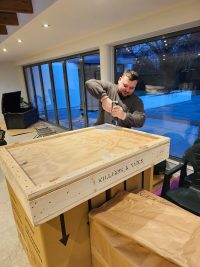
Paintings, sculptures and statues are measured at the survey, so their crates are built in our workshop and ready before collection day. Every piece is crated and wrapped before it goes near the vehicle. Clients often tell us that making our own bespoke crates is why they chose us, and the workshop sits at the heart of our fine art removals service.
Antiques containing protected materials, such as ivory, tortoiseshell or certain rosewoods, need CITES documentation before they can travel. We handle that documentation for you, and our guide to CITES permits for antiques and fine art explains how the system works.
Wine is handled separately from the rest of your household. Alcohol is dutiable in Australia, so each bottle is listed on its own inventory with its make, year, value and alcohol percentage. One of our crew can complete it for you for an additional fee, and our wine collection removals page explains how we move cellars, alongside our wider specialist items service.
-
Australian Biosecurity: What to Expect and How to Prepare
Australia’s Department of Agriculture, Fisheries and Forestry (DAFF) assesses imported household goods, starting with your B534 statement and packing list, and uses them to decide how much of the consignment must be presented for inspection. Goods that do not meet its conditions can be cleaned, treated, destroyed or exported at the owner’s cost.
DAFF’s guidance on moving to Australia and importing personal effects sets out the current process. For any item you are unsure about, check the Biosecurity Import Conditions system (BICON), which sets out Australia’s import conditions and whether a permit is needed.
We build the preparation into how we run your move:
- Outdoor and garden equipment, bicycles, camping gear and footwear are cleaned of soil and plant material before packing, in line with DAFF’s guidance on preparing personal effects.
- Food is left out of the consignment.
- Every item is described on the inventory by its material, for example a wooden chair or a cane basket, rather than “furniture” or “household goods”.
- Boxes are numbered to match the inventory, one number to each box or large item, so an officer can find what they need quickly.
Wooden items, wicker, rattan and bamboo are checked against BICON. Wooden pieces, antiques included, must be clean and free of bark, insects and soil, and DAFF’s guidance on importing wooden and bamboo articles explains what officers look for. Your coordinator will advise on any particular piece.
Fresh food, plants, seeds and soil, weapons, and medication without a prescription should not be packed at all. The Australian Government publishes the full lists through DAFF and the Australian Border Force’s guide to what you can bring into Australia.
-
-
Customs, Duty and Paperwork for Your Household Goods
Australian customs clearance runs through the Unaccompanied Personal Effects (UPE) concession, administered by the Australian Border Force. Personal and household effects you have owned and used overseas for at least 12 months before leaving for Australia can generally be cleared without duty or GST. Newer goods are assessed for duty and GST.
Eligibility depends on your circumstances and the type of goods, and your coordinator confirms how the concession applies to you. Some goods fall outside it entirely: alcohol (covered in the wine section above), tobacco, cars and other vehicles, goods intended for sale, goods bought in Australia, and bequeathed goods.
Your coordinator gathers the paperwork for you:
- A copy of your passport, and your visa if you do not hold an Australian passport
- Your full Australian and UK addresses
- The inventory, which we complete
- The Unaccompanied Personal Effects Statement (form B534)
- The original bill of lading
Your visa is a separate matter from clearing your belongings, and we do not advise on immigration.
Sea Routes, Transit and Planning for the Gap Between Homes
The sea voyage is the main leg of any move to Australia. Fremantle, the port serving Perth, is typically the nearest Australian port on the route from the UK, with the eastern cities further round the coast. Durations vary with the sailing and the load type, so your coordinator will advise on timing for your move.
In most cases your belongings arrive some time after you do. People who have made the move often describe living with borrowed or second-hand furniture while they wait, so it pays to plan for the gap from the start.
Air freight can bring the essentials you cannot be without, and destination storage holds your belongings if your new home is not ready. Once your property is confirmed, we set a coordinated delivery date.
Taking Your Car or Pets to Australia
Australia requires import approval for vehicles. A car brought in as personal effects needs a concessional RAV entry approval, applied for online through the ROVER system under the Road Vehicle Standards Act. Broadly, you must have owned the car continuously for at least 12 months before arriving to live in Australia, and apply within six months of arrival.
We offer vehicle transport, and your coordinator will advise on whether your car qualifies and how best to move it.
Australia’s rules for pets are strict and permit-led. UK cats and dogs complete a period of post-entry quarantine at the government facility at Mickleham, near Melbourne. We offer full pet relocation, and your coordinator guides you through each step.
Moving to Cities Across Australia
In Sydney, the arrival end turns on access at your new address and the timing of delivery and unpacking, both covered in detail on our page on removals to Sydney.
Our page on removals to Melbourne covers the arrival end in the same detail for families settling in Melbourne.
We also arrange moves to Brisbane, Perth, Adelaide and regional Australia.
Planning a move further afield? See all our international removals destinations, or speak to our team about a tailored survey.
Moving to Australia checklist
Documentation
Below is a list of the documentation required when moving to Australia. Our International Move Coordinators will be able to talk you through all the documentation you need.
– Passport copy
– Visa copy (If not using an Australian passport)
– Full Australian and UK address
– Inventory of everything going (Williams & Yates team will complete)
– Unaccompanied Personal Effects Statement (B534 Form)
– Original bill of lading
Duties & Taxes
– All household effects going into Australia have a physical examination, completed by the Australian Inspection Service (AQIS).
– Providing all goods are household effects that are less than 12 months old, shipments are duty free.
– Alcohol is subject to duty. It you do opt to transport alcohol, the inventory must be completed with the value, volume and percentage alcohol content.
Items prohibited for removal to Australia
– Medication should not be transported unless prescribed by a doctor, this will need to be produced at customs.
– Foods including but not limited to Fresh fruit & vegetables, meat, dairy and grains etc.
– Weapons and explosives including, firearms, fireworks and martial arts weapons.
– Plants including flowers, dried plants, seeds, soil and buds.
– Any item imported without an Australian import permit may result in a fine or a jail term in extreme circumstances.
Speak to us about your move to Australia
Talk to one of our International Move Coordinators about your planned move.
Speak to usMoving To Australia FAQs
-
How Much Does It Cost to Move from the UK to Australia?
The cost depends on the volume you are moving, whether you choose a shared or full container, the level of packing and crating, access at both addresses and the services you need on arrival, such as storage or unpacking. A survey gives you an itemised quote built around your move.
-
What Is the Difference Between Groupage, Part Load and a Shared Container?
There is no difference. Groupage, part load and shared container all describe belongings travelling in a container shared with other households, where you use only the space you need. A full container load is used for your belongings alone and typically suits a whole-house move.
-
How Do I Choose a Removals Company for Australia?
Look for international accreditation such as FIDI/FAIM, plus BAR, IAM and Which? membership. Ask whether you will have a single named coordinator, who completes the inventory for Australian customs and biosecurity, and exactly what the quote covers at the destination end, from clearance to unpacking.
-
What Can't I Take to Australia?
Fresh food, plants, seeds and soil, weapons, and medication without a prescription are among the items restricted or prohibited, and wooden items, wicker and bamboo carry conditions too. Check anything you are unsure about in BICON. DAFF and the Australian Border Force publish the full lists.
-
Does Australia Inspect Household Goods?
Yes. The Department of Agriculture, Fisheries and Forestry assesses your B534 statement and packing list, then decides how much of the consignment to inspect. Goods that do not meet the conditions can be cleaned, treated, destroyed or exported at your cost. Clean items and a detailed inventory reduce the risk.
-
Is It Worth Moving Furniture or Buying New?
Quality pieces, antiques and anything hard to replace are usually worth moving, while inexpensive flat-pack furniture usually is not. Whatever you take, plan to be without your belongings for a period after you arrive. Your coordinator can help you decide which pieces suit your new home.
-
Will My UK Appliances Work in Australia?
Australia uses essentially the same supply as the UK, 230V at 50Hz in most areas, so most UK appliances will run there. The plugs are different and need adapting or replacing. Large appliances are not always worth the space they take, so check with your coordinator which ones to bring.
-
Can I Take My Car or Pets?
Yes. Cars need Australian import approval and must meet the conditions for personal effects vehicles, and pets follow a strict, permit-led process that includes quarantine. We offer vehicle transport and full pet relocation, as covered in the section above.


Would strongly recommend for a European move. I have moved within Europe five times in the last 15 years and this is by far the best service. I went for the groupage option as it was cost effective. My items arrived on time and in the same condition they left in. Thank you.
Ms Gjorevska
Book your survey
To book or ask us a question, call us on 0208 081 0188 or get in touch.