
Removals to Zurich
Zurich is an easy city to underestimate. The old town sits inside a vehicle ban with a narrow morning delivery window, the street outside your new address has to be formally reserved with the city before a vehicle can stand in it, and a great many apartment buildings have a stairwell or a lift that will not take the furniture you are bringing. Very little of the difficulty is in the distance. It is in the last two hundred metres, and in the order Swiss customs expects the paperwork to arrive.
Williams & Yates coordinate removals to Zurich for private clients taking up banking, wealth management and asset management roles, for senior executives relocated by employers in tech and pharma, and for households run day to day by a PA or a family office. Every move runs through one dedicated coordinator, who stays with you from the first conversation to the last piece set down in the new home.
Why Clients Choose Williams & Yates for Zurich
One person holds your move. Your coordinator confirms the Kreis and the building before anything is booked, applies to the city for the parking reservation, checks whether the address sits inside a pedestrian zone, arranges an external furniture lift where the stairwell rules one out, and sequences the customs clearance around where your Swiss residence formalities have actually reached. That is several different authorities and trades. You deal with one number, and you never explain your move twice.
Behind your coordinator sits a European export team who handle Swiss frontier formalities as a matter of routine. This is a route we run constantly rather than occasionally, which is why your documentation reaches you as a clear sequence you can work through rather than a pile of forms.
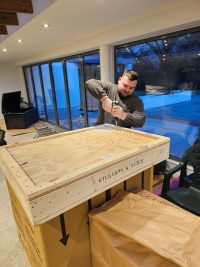
We also make our own crates. They are built in our own workshop to each piece’s measured dimensions, in ISPM 15 compliant timber for international consignments, rather than ordered to a standard size. That matters more in Zurich than in most cities, because a piece leaving through a window on a hoist has to be crated for the window it is going through.
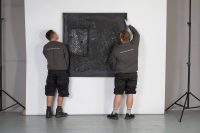
The clearest illustration of what that adds up to is a recent 1,850 cubic foot move from Mayfair to Zurich, with a second collection address in Surrey. Eight gilt-edged mirrors, six antique chandeliers, two floor-bolted safes and a temperature-controlled wine collection travelled in the same relocation, alongside a wine fridge that had to go in through a window at the Zurich end. Our sales manager Shane talks the whole job through in our Mayfair to Zurich case study.
Williams & Yates hold FIDI/FAIM accreditation, the international removals industry’s highest standard. We are BAR and IAM members and Which? accredited. In practice that means trained crews, proper protection in transit, and a payment guarantee sitting behind a booking made well before anything leaves the UK.

From Survey to Quote: How a Zurich Move Is Planned
Every Zurich move starts with a survey at your home, in person or virtually. A surveyor establishes the volume, works through the access at your UK address and assesses each item for the care it will need in transit. Anything needing a bespoke crate is measured there and then, so the cases are built and waiting by collection day rather than made around the move.
The survey also sets the shape of the job. Volume tells us the size of the crew and the number of days needed at your end, and a piano or a chandelier brings in a specialist for as long as that piece takes. On the Mayfair move that came to three days of collection, a day in Surrey and two in Mayfair, with a team of four, plus the chandelier specialist working alongside them. We prepare the inventory on your behalf, and you receive a tailored quote covering the move door to door alongside the direct line of the coordinator who will run it.
The Zurich end is settled at the same time. Your destination property cannot be walked in person the way your own home can, so we assess it remotely, using street-level mapping and screenshots shared with you, then ask the specific questions the delivery will turn on. Which floor, what the stairwell turns like, whether the lift will take a wardrobe or whether a window has to come out. Those answers change the crew, the vehicle and the equipment, so they are settled weeks ahead rather than discovered on the pavement.
Arrange a tailored home survey and we will set out what your Zurich move involves, in writing.
Swiss Customs and the Order Your Zurich Arrival Happens In
Your consignment travels by road from your UK home to the Swiss frontier, where removal goods are cleared as Übersiedlungsgut, household removal effects. The central condition on the customs office’s own page is that you are genuinely transferring your residence to Switzerland, and goods must as a general rule have been personally owned and used by you for at least six months before the move.
We cannot complete your customs declarations for you. What we do is tell you which documents are needed, in what order and by when, then manage the process and the deadlines so nothing reaches the frontier incomplete. Return your documentation on schedule and the consignment clears cleanly, with far less exposure to unexpected duties and taxes.
Two things about Zurich catch people out, and both are scheduling problems rather than paperwork problems.
The first is that clearance of removal goods can only be handled during the customs offices’ hours for commercial goods, on weekdays, and the vehicle uses the commercial lane rather than the private one. That is a constraint on the arrival, and your coordinator plans the road leg around it.
The second is the sequence. Your goods do not have to wait for your city registration to be complete, but the officer at the frontier is looking for evidence that the residence transfer is genuine and imminent, which in practice means an employment contract, a tenancy agreement or a residence permit. Separately, the City of Zurich requires you to register your arrival within 14 days of the actual move-in date, you cannot register before you have moved in, and arrivals from abroad are handled by appointment at a specific registration office. So registration comes after the delivery, while the evidence supporting the customs entry has to exist before it. Your coordinator sequences the two, which is the part clients most often expect to have to solve themselves.
The Switzerland removals page covers the general Swiss customs picture and the transport options across the route, including dedicated and part-load vehicles.
Zurich Access: Parking Reservations, the Kreise and Furniture Lifts
Zurich divides into 12 numbered districts, the Kreise, and where a delivery lands changes the job entirely. A Kreis 1 apartment in the old town, a hillside house on the Zürichberg and a new-build out at Oerlikon in Kreis 11 are three genuinely different deliveries, and we settle which one you have at survey.
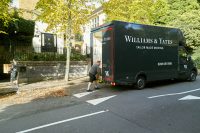
Reserving the street is a formal process, and it is one we handle rather. The City of Zurich runs an official parking space reservation, the Parkplatzreservation, for occupying parking bays during a move. Your coordinator makes that application on your behalf, in advance, so the bay is held before the vehicle arrives. Where a move runs across more than one address, each one needs arranging in its own right, as all three did on the Mayfair job.
The old town operates on a delivery window. Zurich’s pedestrian zones, including the Niederdorf on the right bank of the Limmat and the stretch running through the Lindenhof and Münsterhof on the left, sit under a general vehicle ban. The city’s own guidance states that access is permitted only between 05:00 and 12:00, that entry outside those hours needs a separate access permit obtained in advance, that vehicles must move at walking pace, and that loading may only take place where at least three metres of clear passage remains for pedestrians. Those are the city’s rules, not our service standard, and they set the shape of an old town delivery: an early, tightly run morning, with the vehicle standing wherever the width allows.
Then there is the building itself. Narrow stairwells, spiral staircases and undersized lifts are common in Zurich’s older stock, which is why an external furniture lift, hoisting pieces through a window or over a balcony, is a routine and planned-for part of many Zurich deliveries.
Fine Art, Chandeliers, Safes and Wine Collections
Fine art, sculpture, antiques and delicate items travel in crates made in our own workshop to each piece’s measured dimensions, and heavier pieces are given their own crew where the handling calls for it.
Some pieces need more than a crate. Gilt-edged mirrors are the clearest case, because the fragility is all in the edges and a mirror resting on one will be damaged by the journey. Each mirror goes into a crate built for that mirror, with a batten fixed inside so it hangs exactly as it would on a wall and nothing bears on the gilding. Eight of them travelled that way on the Mayfair move.
Chandeliers go to a dedicated specialist, one of only a handful in the UK, who dismantles each one, removes and individually wraps every crystal and packs them to a set method. Larger chandeliers travel in chandelier crates with a hook in the top, so the piece hangs inside the case rather than resting on its base, and the same specialist rebuilds and reinstates each one at the destination property.
Wine is the one part of the household that does not travel with everything else. A wine collection moves in a separate refrigerated vehicle, temperature controlled throughout, with red and white held in their own zones. It also sits outside the relief that covers your used household goods, so duties and taxes are payable and it needs its own inventory recording the make, year, value and alcohol percentage of each bottle. That goes to our customs agent, who calculates what is due. Most clients complete that inventory themselves because it is the most cost-effective route, and where a client would rather not, we can send a crew member to do it for them.
Our custom crating workshop, fine art removals service and piano removals pages cover this in full, and pieces made from protected species need CITES documentation, which we handle. Our guide to fine art transport to Switzerland covers that and the customs treatment of artwork.


Zurich's Neighbourhoods: The Lake, the Gold Coast and Beyond
Zurich’s residential geography runs outward from the lake, and each part of it presents a different delivery. Kreis 1, the Altstadt, is the tightest: narrow lanes, the pedestrian zone rules above and stairwells never built for modern furniture. Seefeld and the wider Kreis 8 on the eastern lakeshore is dense apartment territory, where the constraint is usually the lift and the loading position rather than the street. The Zürichberg above the city is house territory on a gradient, where the question becomes whether the vehicle can reach the property at all. Out at Oerlikon and across Zürich Nord, the newer stock is far easier to load into and the planning shifts to the parking reservation.
Beyond the city boundary, the Goldküste or Gold Coast runs along the eastern shore through Zollikon, Küsnacht, Erlenbach and Herrliberg, with the western Silberküste taking in Kilchberg, Rüschlikon and Thalwil. Those are estate-agent names rather than official designations, but they describe a real pattern: larger properties behind private drives, where gate width, gradient and turning space matter more than stairs.
None of this can be read off a postcode, which is why we assess every destination property individually. For a broader view of where to settle, our where to live in Switzerland guide is a good starting point.
Delivery, Unpacking and the Finished Home
The Zurich end is a service in itself, not the tail of the journey. Every item is carried into the room of your choosing, unwrapped to a clear surface, the furniture reassembled and the crated pieces lifted out and set down.
How far that goes is your choice. A debris clear unpack takes everything out of the boxes and onto clear surfaces so you can put your own things away, which most people prefer for a kitchen. A full white-glove service goes further, with cupboards wiped down, belongings put away, beds dressed with duvets and bedsheets and the house set up so the family can sleep there that night. Either way the packing materials leave with us, and we walk the property with you at the end.
Dates rarely line up neatly on a cross-border move, particularly when a tenancy start, a permit appointment and a delivery slot all have to agree with one another. Where the Zurich property is not ready, your consignment can be held in short-term storage at our depot until you confirm it can receive the load. We plan for that pause rather than react to it.
Pets and vehicles are handled as part of the same relocation and coordinated by the same person, so they do not become a second set of arrangements running alongside the move.
Arrange Your Zurich Move
Arrange a tailored home survey and you will receive a written quote, a full inventory prepared on your behalf, and the direct line of the coordinator who runs your move from that point on. You can also call us on 0208 081 0188.
For a broader view before you commit, our guides to moving to Switzerland and tax in Switzerland for UK expats are a good place to start, alongside the European removals hub.
Arrange a SurveyZurich Move FAQs
-
How long does a move to Zurich from the UK take?
Timing depends on volume, crating requirements, your documentation and how your Swiss permit and registration fall, and your coordinator confirms it after the survey. We do not quote a fixed day count in advance, because the customs offices’ weekday clearance hours and the notice period on the Zurich parking reservation both sit inside the schedule.
-
What does your quotation include?
The move door to door: packing, export wrapping, crating, collection, the road transit, the Swiss customs clearance, the parking reservation at the Zurich end, delivery into the rooms of your choosing and unpacking. A furniture lift, an external elevator or a glazier is identified at survey and priced in rather than added afterwards.
-
Is the vehicle dedicated to my move, or shared with other consignments?
Most Zurich moves travel on a dedicated vehicle, so the whole load is yours and nothing else shares the space or the schedule. We also run a part-load service on our European road routes, worth considering where the volume is smaller and your dates are flexible. Your coordinator will talk both through at survey.
-
Who will actually be in my house?
In the UK, our own crews, working under your coordinator, who will tell you in advance who is attending and when. Specialists join them where a piece calls for it, a chandelier specialist, for example. At the Zurich end your coordinator confirms the same, and on larger moves we fly a project manager out to oversee the delivery and the unpack in person.
-
Can you collect from more than one address?
Yes. A main residence and a second home are routinely collected on separate days and consolidated into one consignment, with the parking arranged at each address in turn.
-
Can you produce a full inventory for my employer or relocation provider?
Yes. We prepare itemised, valued inventories in the format your relocation department, employer or insurer asks for, and we can arrange billing directly with an employer or a relocation management company.
-
Do you move safes, and what about their contents?
We move and reinstate the safe itself, unbolted at collection by a specialist and put back in situ at the Zurich end. You empty it beforehand and the contents stay with you. Under our terms we do not carry cash, jewellery, watches or precious metals at any value.
-
What if the Zurich property is not ready when my belongings arrive?
This is common enough that we plan for it. Your consignment can be held in short-term storage at either end, and your coordinator sequences the delivery around your registration appointment and the date the property can actually receive the load.
-
I'm also considering Zug or another canton, can you help?
Yes. What we need is a settled delivery address early enough to plan around, since the access, the permit and the registration all follow the property rather than the employer. Our moving to Switzerland guide covers canton comparison, and the tax question belongs with your own adviser.
To book or ask us a question, call us on 0208 081 0188 or get in touch.