Moving Fine Art, Antiques and High-Value Collections to Switzerland
For most households, a move to Switzerland is a question of careful packing, documentation, and well-managed logistics. For those whose homes contain fine art, antiques, sculptures, wine collections, or other high-value and irreplaceable possessions, the process is considerably more involved. Swiss import regulations, CITES wildlife protection requirements, the physical demands of an Alpine transit, and the specialist requirements of bespoke crating all introduce a level of complexity that requires dedicated expertise at every stage.
This guide covers the main considerations: how collections are transported from the UK to Switzerland by road and by air, what Swiss customs duties and VAT apply on arrival, the CITES documentation required for certain materials, and how specialist packing and crating protects individual pieces in transit.
Transport by road
Road is the standard method for most collection moves from the UK to Switzerland, and for good reason. A dedicated, climate-controlled vehicle, loaded and sealed under supervision and driven directly to the Swiss destination, provides the simplest chain of custody and the fewest handling points between packing and delivery. Door-to-door transit from the UK typically takes a few days, depending on the collection’s scale and destination canton.
Vehicles used for fine art transit are equipped with air suspension to absorb vibration on the road and in the Alpine approaches, and with active temperature management systems to maintain stable conditions throughout the journey. For paintings on canvas, panel paintings, lacquered furniture, gilded frames, ceramics, and works on paper, humidity and temperature fluctuation in transit is a genuine risk. A correctly specified vehicle manages those conditions consistently throughout the full journey, not only in ideal circumstances but across the range of weather and seasonal conditions encountered on a UK to Switzerland crossing.
Road transport carries none of the size or weight restrictions that apply in air freight, which makes it the natural choice for large-format works, heavy sculptures, oversized furniture, or any collection where individual pieces are not easily broken into smaller consignments. For families consolidating a collection move with a full household relocation, road allows the collection to travel either within the main consignment or in a dedicated vehicle running alongside it, under the same documentation and coordinator management throughout.
Customs clearance at the Swiss border is handled by the move coordinator as part of the standard process. All documentation is prepared and submitted in advance so that nothing is held or delayed at the crossing.
Transport by air
Air freight is the appropriate choice when speed matters most, when a single high-value piece needs the shortest possible time in transit, or when a collection is being moved from a location where road logistics are more complex. Geneva Airport and Zurich Airport both handle specialist art freight, and Geneva in particular has established procedures for high-value consignments that feed directly into the Geneva Freeport’s storage and customs infrastructure. Where a piece is being placed directly into freeport storage, air freight and Freeport delivery can be coordinated as a single chain, managed by your coordinator from departure through to confirmed receipt.
The packing requirements for air freight differ from those for road. Atmospheric pressure changes in an aircraft hold, combined with a different vibration profile, require crating materials and construction methods specified for those conditions. Pieces that are sensitive to pressure or that have delicate or unstable surfaces need crating reviewed specifically for the air environment, not simply adapted from a road transit specification. At Williams & Yates your coordinator will manage the build accordingly.
CITES documentation requirements apply equally to air and road shipments. The mode of transport has no bearing on what permits are needed or how they are obtained.
Swiss customs duties and VAT
For families moving to Switzerland and importing a collection as personal effects, the starting point is the change of residence provision. The Swiss Federal Office for Customs and Border Security (BAZG) permits the duty-free, VAT-exempt import of personal effects, including fine art and antiques, on establishing Swiss residence, provided the items have been owned and in personal use for at least six months before the move, are not sold within one year of import, and the relevant documentation is complete before the consignment reaches the border. For most families relocating a collection that has been part of the household for years, this provision covers the large majority of what they are moving.
For items that fall outside the change of residence exemption, pieces acquired shortly before the move, or a collection arriving separately at a later date, the Swiss customs tariff is generally favourable for art and antiques. Original works of art including paintings, drawings, sculptures, and original prints attract 0% customs duty under the Swiss tariff schedule, as do antiques demonstrably over 100 years old. VAT at the applicable rate applies to imports that do not qualify for the personal effects exemption, and the specifics depend on how the import is structured and the nature of the items involved. For any collection with pieces falling outside the straightforward change of residence scenario, specialist customs advice is worth taking before the move date is fixed.
The Geneva Freeport is a further option for collectors who are not importing a collection into personal use immediately. Goods held in the Freeport are under customs suspension: import duties and VAT are deferred for as long as the items remain in storage. It is a well-established arrangement used by major collectors, institutions, and auction houses, and allows pieces to be assessed, loaned, or transferred in ownership without triggering an immediate import duty event. For significant collections where part of the holding is not yet destined for a specific property, the Freeport can be a practical staging point.
CITES documentation
Certain objects commonly found in private collections are subject to CITES controls, the Convention on International Trade in Endangered Species, which governs the movement of items containing materials derived from protected species. Switzerland enforces CITES at its borders, and all documentation must be in order before the consignment leaves the UK.
The materials most frequently encountered are elephant ivory, which appears in antique furniture inlays, piano keys, silverware handles, and decorative objects; tortoiseshell from the hawksbill turtle, found in boxes, frames, and furniture inlays; tropical hardwoods including rosewood and ebony, common in antique furniture and musical instruments; and coral, which appears in decorative pieces and jewellery. These materials turn up in collections far more often than their owners anticipate, particularly in pieces held for decades without the question having been raised before.
To export CITES-listed items from the UK, a permit from APHA (Animal and Plant Health Agency) is required. For items made before 3 March 1973, a pre-Convention certificate is also required. Both are confirmed in GOV.UK guidance on CITES imports and exports. Swiss import documentation is required from BAFU/OFEV, the Federal Office for the Environment. Both sets of permits must be in place before departure. From initial collection review to permits confirmed, the process typically takes two to three months. Your coordinator manages this throughout, working with the relevant authorities on both sides.
Types of collection and specialist packing
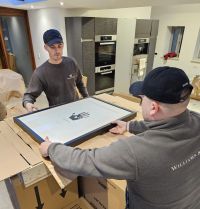
Fine art and antiques need packing that goes well beyond what a general removal company can offer. We run an in-house crating workshop, building bespoke crates designed around the specific requirements of each individual piece, its dimensions, material sensitivity, structural fragility, and the conditions of its transit method.
A large oil painting on canvas, a bronze sculpture, a piece of Chinese porcelain, and an 18th-century French commode each present entirely different problems. The crate is built for the specific piece: internal suspension for fragile canvases, foam profiling for sculptures with complex surfaces, acid-free materials throughout for works on paper and panel, and vapour barriers where climate sensitivity requires them.
Every crate is documented as part of the consignment record, supporting both Swiss customs clearance and the insurance position.
For musical instruments containing CITES-relevant materials, documentation requirements must be confirmed before packing begins. For wine collections, temperature-controlled transport is required throughout, coordinated alongside the customs import process. For classic or high-value vehicles, the practicalities are assessed case by case and your coordinator will advise on the options. Whatever the nature of your collection, the earlier the assessment begins the more time there is to plan for the specific requirements of each category.
Insurance
Fine art moving to Switzerland should be covered by a specialist all-risk transit policy, not a standard household contents extension. Cover should be in place before packing begins, on an agreed-value basis using a current independent appraisal for each significant piece. This is the standard used by museums and major collectors, and it is the appropriate baseline for any collection of meaningful value. Your coordinator can advise on documentation requirements and connect you with appropriate specialist insurers as part of the planning process
Ready to discuss your collection?
If your move includes a collection of any kind, paintings, sculptures, antique furniture, instruments, wine, or other high-value possessions, raise it at the very start of planning. The lead time for documentation and crating is longer than a standard household move, and the earlier the process begins, the more options are available on timing, transport method, and how different parts of the collection are handled.
To discuss your collection and what your move to Switzerland involves, contact the Williams & Yates team.
To book or ask us a question, call us on 0208 081 0188 or get in touch.