
Removals to Geneva
Geneva is a small city with an unusually demanding moving problem. Much of the residential stock is older and lift-less, the Old Town sits behind access bollards, and a very large share of the people who work in the city live over the border in France, which changes the customs route entirely. Distance is the easy part of removals to Geneva. The work is in the detail, settled before anything is loaded.
Williams & Yates coordinate moves to Geneva for private clients taking up finance and private banking roles, for diplomatic postings, and for positions with the international organisations based in the city. Every move runs through one dedicated coordinator, who stays with you from the first conversation to the last piece set down in the new home.
Why Clients Choose Williams & Yates for Geneva
Geneva asks more of the coordination than most European destinations, and that is the case for the way we work. One person holds your move. They confirm which country you are genuinely declaring into, sequence the customs clearance around your registration with the canton, apply for the permission to reserve the street outside your new home, check the current Old Town access hours, and book the glazier if a window has to come out. Those are five different authorities and trades. You deal with one number.
Behind your coordinator sits a European export team who handle the Swiss frontier formalities as a matter of routine, alongside a dedicated European move manager. This is a route we run constantly rather than occasionally, which is what allows your documentation to arrive as a clear timeline with firm dates rather than a pile of forms.
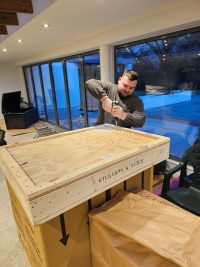
We also make our own crates, built to each piece’s measured dimensions and in ISPM 15 compliant timber for international consignments. That matters in Geneva, because a piece going through a window on a hoist has to be crated for the window it is going through.
Williams & Yates hold FIDI/FAIM accreditation, the international removals industry’s highest standard, and we are BAR and IAM members and Which? accredited. In practice that means trained crews, proper protection and a payment guarantee behind a booking made well before anything leaves the UK.

From Survey to Quote: How a Geneva Move Is Planned
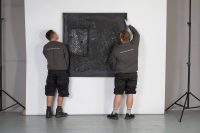
Every Geneva move starts with a survey at your home, in person or virtually. A surveyor establishes the volume, works through the access at your UK address and assesses each item for the care it will need in transit. Anything needing a bespoke crate is measured there and then, so the cases are built and waiting by collection day rather than being made around the move.
The survey also sets the pace of the job. A crew will pack, wrap and load in the region of 500 cubic foot in a day, so the volume tells us the size of the team and the days needed at your end, and a piano or a chandelier brings in a specialist for as long as that piece takes. We prepare the inventory on your behalf, and you receive a tailored quote covering the move door to door alongside the direct line of the coordinator who will run it.
The Geneva end is settled at the same time. Your destination property cannot be walked in person the way your own home can, so we assess it remotely, using street-level mapping and screenshots shared with you, and then ask the specific questions the delivery will turn on. Which window will be used, how it opens, whether it is single or double glazed, whether a glazier is needed first. On a recent Surrey to Geneva relocation, that remote assessment established weeks in advance that several of the larger pieces would go up neither the lift nor the internal staircase.
Arrange a tailored home survey and we will set out what your Geneva move involves, in writing.
Swiss Customs and the Sequencing of Your Arrival
Your consignment travels by road from your UK home, through France, to the Swiss frontier. Removal goods entering Switzerland are cleared under form 18.44, administered by the Federal Office for Customs and Border Security. The Switzerland removals page covers the general Swiss customs picture and the transport options across the route.
We cannot complete your customs declarations for you. What we do is tell you which documents are needed, in what order and by when, then manage the process and the deadlines so nothing reaches the frontier incomplete. Return your documentation on schedule and the consignment clears cleanly, with far less exposure to unexpected duties and taxes. On the Surrey move, the work asked of the client came to a few hours in total.
Sequencing matters more in Geneva than most people expect. Anyone settling in the canton must announce their arrival to the Office cantonal de la population et des migrations within 14 days, and for non-EU nationals that notification and the residence permit application form part of the same procedure. Your coordinator plans the delivery around where that process has reached, not around a date fixed before you left.
Moving to Geneva but Living Across the Border in France
If your home will be in the Pays de Gex or Haute-Savoie rather than the canton itself, your move is legally a move into France. Customs treatment follows your genuine country of residence, never your place of work, and the two countries run entirely separate processes with different evidence requirements.
This is not an edge case. Geneva canton employed 118,067 foreign cross-border workers at the end of June 2026, around 29% of the Swiss total, according to the cantonal statistical office, most of them living in the neighbouring French departments.
A household genuinely settling in France goes through the French transfer of residence process, declared on CERFA form 10070. That route carries its own tests: at least twelve months of prior residence in the UK, at least six months of prior ownership and private use of the goods, import within twelve months of establishing the French residence, and an undertaking not to sell or lend the goods for twelve months after entry. It also needs a detailed, dated and signed inventory prepared in advance.
That evidence has to be assembled before the load leaves the UK, so it is a decision to confirm at the first call. Where you should be resident, and what that means for your tax position, is a question for a specialist adviser. What we need from you is a settled answer, early, so the consignment is declared correctly the first time.
Geneva Access: The Old Town, Unloading Permits and Hoists
The Old Town is the clearest illustration of what Geneva does to a delivery plan. The City of Geneva is installing further access-control bollards through 2026. Outside permitted hours, entry is limited to authorised users, and the restricted window is widening. Those hours are a moving target, so we confirm the current position at survey rather than working from what was true last year.
Reserving space to unload takes a permit in its own right. The City of Geneva runs a public space permission for house moves through its Service de l’espace public, and applications must be lodged at least ten working days before the occupation begins.
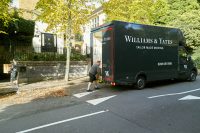
Then there is the building itself. Older properties across Carouge, Plainpalais, Eaux-Vives, Champel and the Old Town commonly have no lift, or a narrow original one, which is why a furniture hoist is a routine part of a Geneva delivery. On the Surrey move a glazier was booked to take the window out before the vehicle left the UK, and the hoisted delivery ran with a team of four. All of it was identified at survey and priced into the quote rather than discovered on the pavement.

Fine Art, Sculpture & Antiques
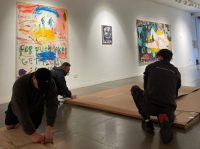
Fine art, sculpture, antiques and pianos travel in crates made in our own workshop to each piece’s exact dimensions, and heavier pieces are given their own crew where the handling calls for it. The piano on the Surrey move is a good illustration. A fourth specialist joined the packing team for a day purely to handle it, alongside the three-person crew working through the rest of the house.
Collectors moving pieces that are not entering immediate personal use often raise the Geneva Freeport. Pieces made from protected species need CITES documentation, which we handle. Our guide to fine art transport to Switzerland covers both in full.
Diplomatic, International Organisation and PA-Managed Moves
Moves for the UN, WHO, WTO, ICRC, CERN and the wider NGO, banking and diplomatic community carry different documentation expectations. We produce itemised, valued inventories in the format your relocation department, employer or insurer requires, and we can arrange billing directly with an employer or relocation management company.
Staff arriving on a carte de légitimation rather than a standard cantonal permit may have access to a different customs process for their belongings, handled through their organisation. Your coordinator will advise on how that affects the sequencing of your move, and will work alongside your organisation’s relocation contact.
A great many Geneva moves are run day to day by a PA or household manager rather than the principal, and we are set up for that. Your coordinator takes instruction from whoever is managing the move and reports back at each stage, so the principal is involved only where a decision genuinely needs them. On larger moves we send a project manager out to Geneva to oversee the crews and the unpack in person, jointly with the PA. Where a household spans more than one address, a main residence and a second home for instance, both can be collected and consolidated into a single move.
High-value pieces are photographed as they are unpacked, so you and your insurer have a record that everything arrived in the condition it left.
Delivery, Unpacking and the Finished Home
The Geneva end is a service in itself, not the tail of the journey. Every item is carried into the room of your choosing, unwrapped to a clear surface, the furniture reassembled and the crated pieces lifted out and set down.
How far that goes is your choice. A debris clear unpack takes everything out of the boxes and onto clear surfaces so you can put your own things away, which most people prefer for a kitchen. A full white-glove service goes further, with cupboards wiped down, belongings put away, beds made up and the house set up so the family can sleep there that night. Either way the packing materials go with us, and we walk the house with you at the end.
Dates rarely line up neatly on a cross-border move. On the Surrey move the Geneva property could not take the consignment when planned, so the load went into short-term storage at our depot until the client confirmed the new home was ready. We plan for that pause rather than react to it.
Arrange Your Geneva Move
Arrange a tailored home survey and you will receive a written quote, a full inventory prepared on your behalf, and the direct line of the coordinator who runs your move from that point on.
For a broader view before you commit, our guides to moving to Switzerland, where to live in Switzerland and tax in Switzerland for UK expats are a good place to start, alongside the European removals hub.
Arrange a SurveyGeneva Move FAQs
-
How long does a move to Geneva from the UK take?
Timing depends on volume, crating requirements, documentation and how your registration in the canton falls, and your coordinator confirms it after the survey. As a point of reference rather than a promise, the transit on one recent Surrey to Geneva move ran to two and a half days including customs clearance, though that reflects that job rather than a service standard.
-
What does your quotation include?
The move door to door: packing, crating, collection, the road transit, customs clearance into Switzerland, the permission to reserve the street at the Geneva end, delivery into the rooms of your choosing and unpacking. A hoist, an external elevator or a glazier is identified at survey and priced in rather than added afterwards.
-
Is the vehicle dedicated to my move, or shared with other consignments?
Most Geneva moves travel on a dedicated vehicle, so the whole load is yours and nothing else shares the space or the schedule. We also run a part-load service on our European road routes, worth considering where the volume is smaller and your dates are flexible. Your coordinator will talk both through at survey.
-
Who will actually be in my house?
In the UK, our own crews, working under your coordinator, who will tell you in advance who is attending and when. At the Geneva end your coordinator confirms the same, and on larger moves we send a project manager out to oversee the delivery and the unpack in person.
-
What if I'll be living in France but working in Geneva?
Then the French process applies rather than the Swiss one, because the country of entry follows your genuine residence and not your employer’s address. Raise it on the first call. The supporting evidence has to be assembled before the load leaves the UK, so it is much harder to correct later.
-
What if the Geneva property is not ready when my belongings arrive?
This is common enough that we plan for it. Your consignment can be held in short-term storage at either end, and your coordinator sequences the delivery around your registration with the canton and the date the property can actually receive it.
-
Can you move pets and a car as part of the same move?
Yes, both are handled as part of the same relocation and coordinated by the same person, so they are not a second set of arrangements for you to run alongside the move itself.
To book or ask us a question, call us on 0208 081 0188 or get in touch.