
Surrey to Geneva: How We Moved a Home, a Piano and a Fine Art Collection to Switzerland
Quick Facts
I get asked a lot what an international move actually looks like from start to finish, so I wanted to talk through a recent one. It was a full house move from Surrey out to Geneva, and it had a bit of everything in it: fine art, a piano, oversized pieces that wouldn’t go through the door, and a fair amount of logistics on the customs side. A good example of the sort of work we do day to day.
- Origin: Surrey, UK
- Destination: Geneva, Switzerland
- Move size: 1,900 cubic foot
- Service: Full packing, export wrapping, bespoke crating, delivery and unpacking
- Specialist handling: Fine art, sculptures, statues and a piano
- Vehicle: 18-tonne removal truck
- Collection: 4 days (team of three, plus a fourth for the piano)
- Transit, including customs clearance: 2.5 days
- Unpacking: 1.5 days (hoisted access through a window)
- Storage: Short-term, while the Geneva property was made ready
-
How It Started
This one began as a move somewhere else entirely. The client had originally planned to relocate to the US, but the visa didn’t come through, so the plan changed and Switzerland became the destination instead. That happens more often than you’d think, and it’s never a problem for us. We just pick the plan up and rework it around the new country.
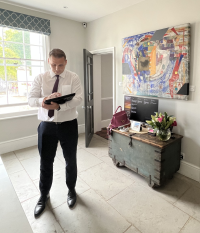
The first thing we always do is get out to the property and carry out a physical survey. That’s where I work out exactly what needs packing, wrapping and crating, the volume we’re dealing with, and all the logistics around it. On this job there were several pieces of fine art, plus sculptures and statues that were going to need crating, so I took measurements there and then. That way, when we turn up on collection day, the crates are already built and ready and nothing holds us up.
Once I had all that, I came back into the office, put a quote together for the move to Switzerland, and the client was happy to go ahead. We booked it in.
-
-

-
Packing and Collection
We turned up to carry out a full, comprehensive packing service. That means we pack everything. The client doesn’t lift a finger.
Collection ran over four days. People are sometimes surprised it takes that long, but the origin end always does. Someone might have lived in a house for twenty years, and there are belongings tucked into every cupboard, every nook and cranny. You can’t rush it, because it all has to be packed properly. As a rough rule, a team will pack, wrap and load around 500 cubic foot a day. This home came in at about 1,900 cubic foot, so the maths puts you at just under four days.
We had a team of three on the packing, with a fourth coming in for a day purely for the piano. Pianos are heavy, awkward and valuable, so they get their own dedicated handling. All the furniture was dismantled and export wrapped, everything was boxed and inventoried, and the fine art, the sculptures and the statues were all crated and wrapped before they went anywhere near the lorry. Then we loaded up. It all went into an 18-tonne removal truck.
The Customs Side
This is the part clients worry about most, and it’s the part we take off their hands. Our European export team runs through all of the customs formalities, the TOR forms and everything else that’s needed. A dedicated European move manager stays on it, telling the client exactly what paperwork we need and when we need it back.
I’m always honest about this bit: there’s a few hours of work in it for the client, no getting around that. But it’s nothing overwhelming, and we guide them through every step. The reason we’re firm on deadlines is simple. Get the formalities done on time and you clear customs cleanly, with no delays and far less risk of duties and taxes. Leave it to the last minute and that’s when problems start. We can’t fill the forms out for the client, but we tell them precisely what to do.
-
Storage in Between
The property in Geneva wasn’t quite ready when we collected, which is very common. So we brought everything from the origin back to our depot and held it in short-term storage. As soon as the client gave us the green light that the new place was ready, we got moving.
The Move to Switzerland
Transit over to Geneva, including the customs clearance, took two and a half days. Then we carried out a full delivery and unpacking service at the other end.
We delivered everything into the rooms the client wanted, unwrapped and unboxed it all down to a clear surface, reassembled the furniture, and uncrated the fine art, the sculptures and the statues. We took photos of those pieces as we went, so there’s a clear record that everything arrived exactly as it left.
The interesting part was access. Several of the larger pieces simply would not go up the lift or the internal stairs. So we brought in a hoist and took them in through a window instead. To do that we arranged a glazier to remove the window first, then we lifted the pieces straight up and in. You need two people at the bottom loading the hoist and two at the top bringing it into the property, so we had a team of four on the delivery that day, with a team of three on the half day for the rest of the unload.
-

How We Handle Access We Can't See
People ask how we plan for access at a property we’ve never set foot in, and it’s a fair question. We can’t survey a home in Switzerland the way we can one in Surrey, so Google Maps becomes our best friend. We do a street check, send screenshots over to the client and ask the right questions. Is this the window you want taken out? Is it double or single glazed? Is it a sash window? We gather as much detail as we can up front so that when we arrive we’ve got the right tools, the right people and the right third parties already arranged. That’s where the planning earns its keep.
-

-
Finishing the Job
Once everything was in, set up and in the right rooms, we cleared away all the packing and wrapping so the client wasn’t left with anything to tidy. Then we did a walkaround together. They were very happy, and we wished them well in their new home.
Start to finish, from collection to our team getting back, it was a few days of collection, two and a half days of transit, a day and a half of delivery and two days back. Not a straightforward A to B by any stretch, but that’s exactly the sort of move we’re built for.
If you’re planning something similar, get in touch and we’ll talk it through.
Contact us
To book or ask us a question, call us on 0208 081 0188 or get in touch.