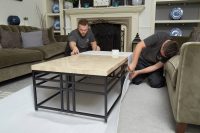
Moving Furniture Overseas, Without a Full House Move
It is easy to assume international removals only begin when an entire household moves. Moving furniture overseas is often about a handful of pieces rather than a home: a sculpture bound for a villa, a design scheme for an apartment abroad, or an inherited cabinet that now belongs somewhere new. Williams & Yates moves furniture, fine art and individual pieces overseas with no full house move attached.
You Don't Need to Be Moving House
Williams & Yates moves furniture and fine art overseas for clients who are not relocating, from a single piece to a whole collection. The service covers interior design and FF&E projects, second and holiday homes, inherited or antique pieces, auction purchases and items leaving Williams & Yates storage.
Interior designers are among the clients who use this most. An FF&E scheme (furniture, fixtures and equipment) for a project abroad rarely comes from one supplier, so pieces are typically gathered, held and delivered once the property is ready to receive them. Our interior design logistics service is built around that rhythm, with inventory-managed storage and installation at the other end. Through our partnership with the British Institute of Interior Design, we work alongside many of its members.
For private clients, it might be a second home in the South of France that needs furnishing, a few inherited antiques that belong in a house overseas, or a painting or console table bought at auction or from a dealer that needs to reach the home it was chosen for. Pieces already held in our secure storage in London and Dunstable can also move on, travelling from our facility to their new address.
Where a PA or household manager is arranging things on a principal’s behalf, we work with them directly throughout.


-
How a Smaller Consignment Travels
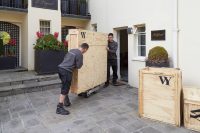
A consignment that does not fill a vehicle or container does not need one to itself. With groupage, your pieces share space with other clients’ goods on an established route. Our guide to moving by sea, air or road covers the wider choice of transport.
Within Europe, we run regular part-load routes serving Paris and the South of France in particular, alongside a road and consolidation service covering every European country. On these routes, a pair of armchairs or a single cabinet is an entirely normal consignment. Our comparison of shared and dedicated loads to France explains how the two options differ.
-
Furnishing a Second Home Abroad
Pieces for a second home may come from your main home, from storage, or from dealers and designers here in the UK. We can collect from several addresses and bring everything together into one consignment, delivered into the property abroad, whether that is an apartment in Paris or a villa further south. Our pages on removals to France and removals to Spain cover those destinations in more detail.
Customs is where a second home differs from a relocation. Relief from import charges on household goods is generally tied to a change of main home. The UK’s own guidance, for example, states that transfer of residence relief cannot be claimed for goods from secondary and holiday homes, and many destination countries take a similar approach.
In most cases, furniture going to a second home abroad, and anything newly bought for it, is treated as an ordinary import and may attract local VAT or duty. Your dedicated move coordinator will advise on what applies at your destination and assist with the customs paperwork.
-
Moving Fine Art, Antiques and a Few Treasured Pieces
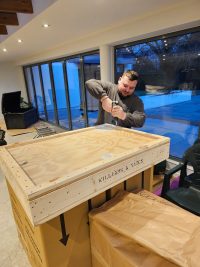
A bronze sculpture, a pair of Georgian chairs or a painting that has hung in the family for decades needs protection built around it. At survey, when we reach the artwork, clients often tell us the reason they chose Williams & Yates is that we make our own crates.
Each piece is measured at the survey, so a crate can be built to specification in our in-house crating workshop and be ready before collection day. Crates for international consignments use certified timber that meets ISPM 15, the international standard for wood packaging. Every piece is crated and wrapped before it goes near the vehicle, with packing materials chosen for each surface, such as oil-based wrapping paper to reduce the risk of sweating.
At delivery, pieces are uncrated in the rooms you choose and photographed as they come out, so you have a clear record that everything arrived as it left. Our fine art removals service covers art handling in more depth, and if a piece needs to wait before or after the move, fine art storage keeps it safe in the meantime.
Antiques containing protected materials such as ivory, tortoiseshell or certain rosewoods may need CITES documentation before they can leave Great Britain, which we handle as part of the move. Our guide to CITES permits for antiques and fine art explains when a permit applies.
-
Do You Need to Ship Furniture Internationally, or Move a Full Household?
If you need a few pieces moved rather than a household, this is the service that fits: a partial consignment, planned around the pieces themselves. If you are relocating yourself, our international removals and European removals services cover the full household move, from survey through to unpacking in your new home.
If you have not yet decided whether your furniture is worth taking at all, our guide to moving it or selling up and rebuying talks through that decision.
Either way, Williams & Yates is FIDI/FAIM accredited and a member of BAR and IAM, and a single sculpture receives the same meticulous attention as a full relocation.
To discuss a consignment, send us an enquiry or call 0208 081 0188. Tell us what needs to move and where it is going, and we’ll arrange a survey.
To book or ask us a question, call us on 0208 081 0188 or get in touch.