CITES Permits for Antiques and Fine Art: What UK Movers Need to Know
If you are relocating abroad with antiques, fine art or a valued collection, a CITES permit may apply to pieces you would never think of as wildlife. The trigger is not the age of a piece, and not what it is worth. It is the material it contains. A Georgian cabinet with ivory inlay, a tortoiseshell dressing set or a rosewood writing desk all fall under the same international convention that governs trade in endangered species.
We identify those pieces at survey and manage the documentation that follows, as a routine part of a full-service international move.
What Is a CITES Permit and When Does It Apply to Antiques and Fine Art
A CITES permit is the document required when an antique, artwork or collectable contains material from a species protected under the Convention on International Trade in Endangered Species. In Great Britain it is issued by the Animal and Plant Health Agency, known as APHA. It is the material in the piece that triggers the requirement, not the item’s age or value.
Under APHA’s guidance on CITES imports and exports, a permit is needed to move a CITES specimen into or out of Great Britain, including movements to and from the EU, non-EU countries, Northern Ireland, Jersey, Guernsey and the Isle of Man. A move from London to Paris sits inside these rules as squarely as a move to New York or Singapore.
Age is where most owners go wrong. A piece that has been in the family for a century is still a CITES specimen if it contains a listed material, and long lawful ownership in the UK is not, on its own, a route around the border requirement.
These rules are enforced. During a single month-long operation in autumn 2025, Border Force officers seized more than 250 endangered species and illegal wildlife products at ports, airports and mail centres, a 73% rise on the previous year. Ivory carvings were among the items taken. Very few of the people caught by these rules are smugglers. Most simply did not know the rules reached their own belongings.
Which Materials in Antiques and Fine Art Are Commonly Protected
Ivory. Elephant ivory is the most frequently encountered CITES material in antiques, and it sits in the strictest tier of control whatever the age of the piece. Ivory from hippopotamus, sperm whale and killer whale is controlled separately under CITES and should not be assumed to follow the same rules. Elephant ivory is also governed domestically by the Ivory Act 2018, which covers sale within the UK rather than movement across a border.
Tortoiseshell. Almost all antique tortoiseshell comes from the hawksbill turtle, which sits in the most tightly controlled bracket. Combs, tea caddies, card cases and inlaid boxes are affected however old they are.
Rosewood and other CITES-listed timbers. Brazilian rosewood is tightly controlled with no meaningful exemption. The wider Dalbergia family was brought into the regulated tier in 2016, and annotations exempt certain categories of finished item from permit requirements. Those annotations are refined at each Conference of the Parties. Around 127 further timber taxa were added following the 2022 Conference, with a delayed tranche taking effect on 25 November 2024, so anything written about timber listings before that date may well be out of date.
Exotic leathers. Crocodilian and python leather appears in fine luggage, upholstery and decorative objects. Most sit in the regulated trade tier, though some populations are listed in the strictest tier, so the position needs checking species by species.
Coral and taxidermy. Most stony corals and black corals sit in the regulated tier. A mounted specimen carries whatever listing status its source species carries, so a Victorian big cat mount is treated very differently from a common bird.
Ivory, bone, horn and early celluloid are not always easy to tell apart by eye, and neither are some tropical hardwoods. Expert verification is often the first step rather than a permit application. Our surveys, in person or virtual, are where these pieces come to light, and your coordinator will arrange specialist verification where a material is uncertain.
Understanding Annex A, B and C
Great Britain does not apply the international CITES Appendix I, II and III system directly. It uses its own Annex A, B, C and D categories under the retained Wildlife Trade Regulations. Annex A is the strictest tier, Annex B the main regulated trade tier, and Annex C covers species controlled at the request of an individual country.
The Annexes broadly follow the Appendices, but not exactly. Great Britain has in some cases chosen a stricter Annex listing than the underlying Appendix requires, so treating Annex A as another name for Appendix I is unreliable. The Species+ database, which GOV.UK directs applicants to, is where an individual species should be checked.
Export Permits, Import Permits and Re-export Certificates: What's the Difference
An export permit covers an item leaving Great Britain. An import permit is issued by the country the item is entering, under that country’s own rules. A re-export certificate covers an item previously imported into Great Britain that is now moving on again.
The current CITES application fees published by APHA are £31 for an Article 10 certificate. Export permits are £63 for animals and £74 for plants, import permits £67 and £74, and re-export permits £37 and £59.
One caveat applies throughout. A UK permit does not oblige the destination country to admit an item. CITES works as a system of matched national permits, and the receiving country’s own management authority decides whether your piece is allowed in, under its own rules. That is a separate conversation, held in parallel, and your coordinator will open it early rather than at the port.
The Personal and Household Effects Exemption, and Its Limits
You will almost certainly have read that antiques are covered by a personal effects exemption. GOV.UK’s plain-English guidance does say you may not need a permit for CITES specimens that are personal and household effects, and it names household furniture and antiques among its examples. Read on its own, that line suggests a house move is exactly the situation the exemption was written for.
For most antiques leaving Great Britain, it is not.
The detail sits in the retained regulation behind that guidance rather than in the guidance itself. Article 58 of retained Commission Regulation (EC) No 865/2006, as it applies in Great Britain, states that the personal and household effects derogation “shall not apply to specimens of species listed in Annexes A or B”. That is the export and re-export side, which is the direction of travel in almost every relocation we handle. Ivory, tortoiseshell, Brazilian rosewood and most listed timbers all sit in Annex A or Annex B. For those materials, on export from Great Britain, the exemption gives no relief at all and the full export permit process applies.
The Pre-Convention or 'Worked Specimen' Route for Genuinely Antique Items
A separate mechanism exists for genuinely antique worked items. Under APHA’s worked specimen guidance, an item qualifies only if it meets all four criteria. It must be significantly altered from its natural, raw state. It must have been manufactured or worked before 3 March 1947. It must not have been reworked to change its purpose since that date. And it must be clearly identifiable as jewellery, an adornment, art, a utility item or a musical instrument.
What qualifying achieves is narrower than most owners expect. Worked specimen status removes the need for an Article 10 certificate, which is what allows an Annex A specimen to be sold or commercially dealt with inside the UK. GOV.UK is explicit that it does not remove the border requirement: “You need a CITES permit to import, export or re-export worked specimens.” These are two different exemptions solving two different problems, and one is not a substitute for the other.
Reworking is where owners lose the status without realising. GOV.UK’s own example is Brazilian rosewood floorboards or panelling later reworked into a guitar. The wood long predates 1947, but the item’s purpose changed, so it no longer qualifies. Sympathetic repair is generally fine. Alteration that changes what the object is, or makes its age harder to verify, is not.
APHA will typically want a statement of verification on age, supported by an expert appraisal, a written declaration from the manufacturer, or a museum or exhibition catalogue. Separately it will want provenance: dated receipts or bills of sale, property titles, customs documentation, or transport and insurance records. “It has been in the family for generations” is a statement about ownership. What APHA needs is documented evidence of age and origin, and those are not the same thing.
Applying for a CITES Permit: Process and Typical Timing
The process runs in three broad stages. The specimen is checked against Species+ to confirm its listing and the correct trade term code. The application is then submitted through APHA’s online CITES permit service, which has replaced the old paper forms. Supporting evidence on age, provenance or origin follows if APHA asks for it.
On timing, APHA states that it reviews each application individually and aims to process applications within 30 days. Some applications are referred to scientific advisers, which can extend matters. Your coordinator will advise on timing for your specific move and will start the documentation well ahead of your packing dates.
Designated Points of Entry and Exit
CITES specimens may only enter or leave Great Britain through a designated port. APHA’s designated ports guidance currently lists 16 airports and 20 sea ports, including Heathrow, Manchester, Birmingham International and Edinburgh among the airports, and Dover, Felixstowe, Southampton ABP and Belfast among the sea ports.
This carries more weight than most owners expect. GOV.UK states it directly: “If you do not use a designated port, UK Border Force can seize your specimen and take criminal action against you and anyone else involved. This applies even if you hold a valid permit.” Documents have to be presented to Border Force in person at the last point of exit.
The list of designated ports is revised from time to time, so we check it against the live guidance for each move rather than carrying it over from a previous one.
How Williams & Yates Manages CITES Documentation for Your Move
The UK remains the world’s second-largest art market, worth an estimated $10.5 billion in 2025, with an 18% share of global sales. A great many protected-species items sit quietly in private collections here without anyone having had cause to think about their status.
For us this is standard practice on fine art and antiques moves rather than a specialist add-on. Your dedicated coordinator identifies protected materials at survey, arranges expert verification where a material is uncertain, prepares and submits the APHA applications, confirms the designated port for your route, and speaks to the destination country’s authority about its own requirements. Where a move spans more than one address, or is run day to day by a PA or household manager, that single point of contact holds the whole documentation picture rather than splitting it across a chain of people.
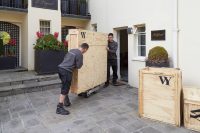
While the paperwork is in progress, your pieces are being prepared. Our in-house crating workshop builds to the object rather than to a standard size. A gilt-edge mirror, for example, hangs from a batten fixed inside its own crate so nothing bears on the fragile edges.
For the wider customs picture, our guide to Transfer of Residence covers how used household goods and personal effects are treated on a permanent move.
Every collection is different, and the only reliable way to know what applies to yours is to have it looked at properly. Arrange a survey or relocation enquiry and your coordinator will take it from there.
Arrange a Tailored Home SurveyTo book or ask us a question, call us on 0208 081 0188 or get in touch.