0208 081 0188
Contact us
0208 081 0188
Contact us
Press enter to begin your search

Removals to Nice
If you have chosen Nice or the wider Côte d’Azur as your new home, the move brings considerations you will not meet in most French cities. Removals to Nice from the UK have to work around an old town the city closes to traffic, tram lines where a furniture lift cannot be used, and hillside homes set well above the seafront. This page covers each one, along with what shapes the cost of your move and how we manage it from survey to unpacking.
Moving to Nice From the UK
We run regular full and part-load routes from the UK to the South of France, and Nice is on a route we serve often. How your belongings travel depends on the size of your move.
A shared load suits a smaller consignment, which travels alongside other clients’ goods on the same route. A dedicated vehicle suits a larger home, or a move where you would prefer the vehicle and its schedule to be yours alone. Our guide to choosing a shared load or a dedicated vehicle for France compares the two in more detail.
The same service reaches the rest of the coast, including Cannes, Antibes, Villefranche-sur-Mer and Menton. If Nice is one part of a wider move, see our removals to France page, and for the principality next door, our removals to Monaco service. Your coordinator will advise on timing once your dates and volume are clear.
Talk to us-

-
What Shapes the Cost of a Move to Nice
The cost of moving furniture from the UK to Nice depends on the volume of your belongings, whether a shared or dedicated vehicle suits them, the access work at your Nice address, crating for fine art or fragile pieces, any storage needed and when you move. We confirm each of these at survey.
We quote a considered move of a valued home after a survey, because in Nice especially, the details that shape the work are often only visible at the address itself.
Volume, Vehicle and Route
The size of your consignment is the starting point. Smaller moves often sit well on a shared load along our South of France route, while a full household, or one with large or delicate pieces, may be better suited to a dedicated vehicle.
If you are moving from more than one UK address, such as a main home and a second home, we can collect from both and consolidate them into a single move.
Access at Your Nice Address
Parking authorisations, access to a pedestrian area and a vehicle-mounted furniture lift all add planning to a move, and each is reflected in your quote. Your survey identifies them early so they can be arranged in advance. The access section below explains the city’s rules.
Crating, Storage and Timing
Fine art, antiques and fragile pieces are packed to suit each item, with bespoke crates built where a piece needs one. If you are buying a new-build apartment, or a property that completes after you leave the UK, we can hold your belongings in secure storage until the keys are yours. Paintings and collections can go into our dedicated fine art storage.
The season you move in also has a bearing, which we cover under timing further down this page.
What a Quote for Nice Should Include
Whichever company you speak to, a quote for a move to Nice should be clear on each of the following. At Williams & Yates, we build every one of these into your survey.
- Collection from each UK address and delivery to your exact address in Nice
- Packing, and crating for fine art or fragile items
- The inventory and customs paperwork
- Transit insurance based on the declared value of your belongings
- Any parking or pedestrian area authorisation, and a furniture lift where the building needs one
- Whether your belongings travel on a shared load or a dedicated vehicle
- Storage, if your moving date and your completion do not align
- Unpacking, to the level you choose
-
Access in Nice: Permits, Pedestrian Zones and Tram Routes
A removal to Nice usually needs advance authorisation from the Ville de Nice, either to park the removal vehicle or to enter a pedestrian area, with at least 5 or 7 working days’ notice depending on where the vehicle stands. Williams & Yates plan these into every Nice move.
The rules below come from the city’s own published guidance. Because every address is different, your survey confirms exactly what your move will need.
Parking Permits for a Removal Vehicle
The Ville de Nice procedure for reserving parking for a move is open to private individuals and professionals. It asks for at least 5 working days’ notice to use authorised parking bays. Occupying a traffic lane or the pavement needs at least 7 working days’ notice, and a roads inspector visits the site first. Working days exclude weekends and public holidays.
The city does not supply the signage used to reserve the space, so this is arranged separately. Your coordinator times the application around your delivery, so the authorisation is in place before the vehicle arrives.
Moving Into Vieux Nice
Vieux Nice, the old town, is a controlled pedestrian area. According to the city’s guide to Nice’s pedestrian areas, motor vehicles may not drive or park there, and retractable bollards operated from a security control room manage access. Delivery vehicles are admitted only between 4am and 10.30am.
A removal into Vieux Nice needs its own authorisation, requested at least 7 working days before the move. It lets the vehicle enter and stop to load or unload within a stated time window. Outside that window, the vehicle must park beyond the pedestrian area.
In the old town’s narrow streets, only vehicle-mounted furniture lifts can be authorised. Many older apartment buildings also have a small lift or none at all, and a building’s own rules may set the hours when its lift can be used for a move. We survey the address first, then plan how each piece will reach your apartment.
Tram Routes and Furniture Lifts
Where Nice’s trams run beneath an overhead power line, that line carries 750 volts permanently, so the city’s pedestrian area guide bans furniture lifts along tram routes with an overhead line. Some stretches, such as place Masséna and place Garibaldi, have no overhead line. Any lifting platform or crane on the tram route needs an authorisation request to the Line 1 operator at least four weeks ahead.
If your new apartment overlooks a tram street, a furniture lift at the front of the building may not be possible. Your survey looks at the alternatives, such as another side of the building or the internal lift, and your coordinator plans the delivery around them.
Hillside Homes in Cimiez and Mont Boron
Many of the area’s villas sit on the hills above the city. The Cimiez hills fall within Nice’s UNESCO World Heritage listing as a Riviera winter resort town, and Mont Boron rises between Nice and Villefranche.
Hillside homes often mean steeper, narrower approaches. Those shape the choice of vehicle and how far your belongings are carried from the road to the door, and we assess both at survey.
Low Emission Zone Rules for Removal Vehicles
Central Nice, including the Promenade des Anglais and the hypercentre, is a low emission zone, or ZFE. Since April 2025, the only vehicles excluded are lorries over 3.5 tonnes, buses and coaches rated Crit’Air 4, 5 or unclassified, so a compliant removal vehicle can still reach addresses in the centre. Foreign-registered vehicles need a Crit’Air certificate, which we hold.
-

Choosing When to Move to the Côte d'Azur
Spring and summer bring the Riviera’s peak visitor season and major events along the coast. Traffic is heavier, kerbside space is harder to secure and removal dates are in greater demand. France also restricts lorries over 7.5 tonnes on certain days, including additional summer Saturdays published by Bison Futé, and your coordinator plans around these.
A quieter month can make access simpler, though your purchase and your family’s plans will usually decide the date. The city’s authorisations need working days’ notice, so speaking to us early gives your coordinator room to plan. Our guide to the best time to move to France covers seasonal planning in more depth.
Customs Paperwork for Your Move to Nice
Since the UK left the EU, belongings moving from the UK to France cross a customs border. Used household goods and personal effects moving with a change of residence can typically enter France without duty, subject to conditions on ownership and arrival. Our removals to France page sets out the customs checklist in full, with the documents you will need.
We prepare the inventory, and your move coordinator handles the customs process with you. Wine is treated differently. It is dutiable, inventoried separately and moved in a temperature-controlled vehicle, as our wine collections service explains.
-
-
Fine Art, Antiques and Yachts on the Riviera
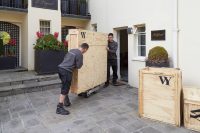
Our in-house workshop builds bespoke crates to the exact size and shape of each piece, using ISPM 15 compliant timber for international consignments. Packing materials are chosen piece by piece. Getting a large sculpture or statue into a Nice apartment can be the harder part. Where a piece will not fit a building’s lift or stairwell, we have brought it in through a window by hoist, with a glazier removing the window first. Because the city restricts furniture lifts in the old town and beneath tram lines, your survey confirms whether that approach is possible at your address.
Our fine art removals team handles paintings, sculpture and antiques, and prepares CITES documentation for items made from protected species. For more detail, see our guide to safely moving art, antiques and valuables to France.
If you keep a yacht on the coast, our yacht services include fine art and interior installation on board.
How Williams & Yates Manage Your Move to Nice
One dedicated move coordinator leads every move to Nice and is your single point of contact from the first survey to the final box unpacked. Surveys take place in person or virtually, whichever suits you.
Many of our clients’ moves are arranged day to day by a PA or household manager. We work alongside them throughout, and can fly a project manager out to Nice to oversee the delivery and the unpack with them.
At the other end, you choose how much we do. A debris clear unpack unpackes everything from boxes and leaves everything on clear surfaces for you to put away yourself. Our full white-glove service puts items away, hand clothes and dresses the beds, so your family can sleep there on the first night. We also arrange vehicle transport and pet relocation, and our guide to moving to France with pets explains what your animals will need.
Williams & Yates are FIDI/FAIM accredited, an independently audited quality certification for international movers. We are also members of BAR and IAM, and Which? accredited. If you are still weighing up the wider move, our guide to moving to France is a good place to start.
When you are ready, request a tailored survey and we’ll begin planning your move to Nice.
FAQs
-
How Much Does It Cost to Move Furniture From the UK to Nice?
It depends on the volume you are moving, whether a shared load or a dedicated vehicle suits it, the access at your Nice address, any crating or storage, and the time of year. Access varies so much between Nice addresses that we quote after a survey, in person or virtually.
-
Do I Need a Parking Permit for a Removal Lorry in Nice?
In most cases, yes. The Ville de Nice asks for at least 5 working days’ notice to use authorised parking bays, and at least 7 working days’ notice to occupy a traffic lane, the pavement or a pedestrian area. Your coordinator times the application around your delivery.
-
Can a Removal Vehicle Get Into Vieux Nice?
Yes, with a temporary authorisation from the city requested at least 7 working days before the move. It covers loading and unloading only, within a stated time window, and only vehicle-mounted furniture lifts can be authorised in the narrow streets.
-
Can a Furniture Lift Be Used on a Tram Street in Nice?
Not where the tram’s overhead power line runs, as it carries 750 volts permanently. Some stretches, such as place Masséna and place Garibaldi, have no overhead line. If your address is on a tram route, your survey plans another way to bring your furniture in.
-
Is a Shared Load or a Dedicated Vehicle Better for a Move to Nice?
It depends on how much you are moving, your dates and how flexible you can be. A shared load suits smaller consignments on our regular South of France route, and a dedicated vehicle suits a larger home. Our guide to shared and dedicated loads for France compares the two.
-
How Far in Advance Should I Plan a Move to Nice?
There is no fixed lead time, but contacting us early helps. The city’s authorisations need working days’ notice, and spring and summer are the busiest seasons on the coast. Your coordinator will advise on timing once your survey is complete.
-
What Paperwork Do I Need to Bring My Belongings Into France?
Your household goods need an inventory and customs documents, which we prepare with you. Wine is declared separately because it is dutiable. The full checklist is on our removals to France page.
-
Is It Worth Moving Furniture and Art to Nice Rather Than Buying New?
For fine art, antiques and family furniture, usually yes, provided each piece is properly packed, crated where needed and insured for its declared value in transit. Your survey is a good point to decide what to move, what to store and what to leave behind.
-
Can You Move Our Car and Pets to Nice as Part of the Move?
Yes. We arrange vehicle transport and pet relocation alongside your household move, managed by the same coordinator. Our guide to moving to France with pets explains what your animals will need.


These guys have been fantastic from quote to move day. They have made the extremely stressful process of moving abroad as easy as possible with fantastic customer service from start to finish. A very happy customer.
Ms Iankov
Book your survey
To book or ask us a question, call us on 0208 081 0188 or get in touch.