Best Places to Live in the Netherlands
Ask most people to name the best places to live in the Netherlands and you tend to get the same four cities back. Amsterdam, Utrecht, The Hague and Rotterdam are the obvious starting points, and there are good reasons for that. They are only part of the picture. Plenty of relocating families and senior professionals look hard at those cities, then quietly settle somewhere just outside them, in towns and villages that rarely make a list of this kind.
This guide covers both. It sets out what each place is like to live in, who tends to end up there, and how the commuting and schooling work. If you are still weighing up the decision itself, our companion piece on why so many people are relocating to the Netherlands covers the reasons.
How to Choose Where to Live in the Netherlands
The best places to live in the Netherlands include The Hague for international institutions, Utrecht for central connectivity, Rotterdam for modern architecture, Haarlem for historic charm near Amsterdam, Amstelveen for international families, Eindhoven for technology careers, and quiet enclaves like Wassenaar, Bloemendaal and the ‘t Gooi villages for space and privacy.
What the Randstad Actually Means
Almost every guide to the Netherlands uses the word Randstad. It is the horseshoe-shaped conurbation in the west of the country containing Amsterdam, Rotterdam, The Hague and Utrecht, along with the smaller towns that have grown up to link them. It is home to roughly 48% of the Dutch population and generates more than half of national GDP. At its centre sits the Groene Hart, a protected agricultural and nature zone, which is why the region reads as a ring of cities around open land instead of one continuous sprawl.
That structure matters for a practical reason. You can live somewhere genuinely green and village-scaled and still be a short train ride from a major city. That is the trade many relocating families make.
The 30-Minute Commute Benchmark
Among people who have already made the move, a rough rule of thumb circulates. If you need to be in Amsterdam regularly, look for somewhere within about 30 minutes by train of Amsterdam Centraal. It is an informal benchmark and not a rule, but it works as a filter, and it explains why certain towns keep appearing on relocating families’ shortlists.
Against that benchmark, Haarlem and Amstelveen sit comfortably inside it. Hilversum and Naarden sit close to or just inside it depending on the service. Utrecht is right at the edge at around 27 minutes. Rotterdam and Eindhoven fall well outside, which is no argument against either. It is a reason to base yourself there instead of commuting from there.
The rail network makes the benchmark workable. NS trains reached their final destination within five minutes of schedule 90.6% of the time in 2025, up from 89.4% the year before. Not flawless, and Dutch commuters will tell you so, but dependable enough to plan a life around.
School First, House Second
For families, the constraint that decides where you live is usually not the house. It is the school.
This is the most consistent piece of advice from families who have recently relocated, and it runs counter to how most people approach a move. The instinct is to find the area, then the house, then sort out schooling. In practice, places at the most sought-after international schools are scarce enough that the sequence reverses. Independent admissions research describes waiting lists of two to four years at the most in-demand international schools, particularly in Amsterdam and The Hague. So the order that works is to identify realistic school options first, define a commutable radius around them, then search for a property inside it.
The Netherlands also tends to reward families who make this move. UNICEF’s 2025 Innocenti Report Card 19 placed the Netherlands first out of 43 high-income countries for child wellbeing, a finding widely reported across Dutch media at the time.
-
The Hague
The Hague splits cleanly into two kinds of housing: grand, tree-lined townhouses and mansion blocks in the embassy districts of Statenkwartier and Archipelbuurt, many of them listed and a few of them embassies in their own right, and modern coastal apartments out towards Scheveningen. It attracts diplomatic and international-organisation households above all, and it carries the country’s largest single concentration of international schools.
That concentration follows directly from what the city does. The Hague hosts around 500 international organisations, including the International Court of Justice and Europol, which is how it came by the title City of Peace and Justice. The embassies, courts and institutions bring a permanent international population, and the schooling has grown to match, with 14 international schools across the wider region.
In character, The Hague is the seat of government without feeling like a capital under pressure. The centre is taller and more corporate than Amsterdam’s. Step a few streets out and it turns quiet, leafy and residential, and it ends at a working beach. Rotterdam is around 26 minutes away by train, Schiphol between 27 and 48 minutes depending on the service.
-
Wassenaar
Ten kilometres north of The Hague and close to the North Sea, Wassenaar is a low-density villa town where a good share of the diplomatic and senior corporate community lives rather than works. Housing runs from historic mansions to modern villas on leafy, often gated streets, set in mature grounds that are generous by Dutch standards.The draw is straightforward. You get space and privacy within a short drive of The Hague’s embassies and institutions. Estate agents and relocation sources consistently describe an unusually high international resident share, though the precise proportion varies by source and should be treated as indicative rather than exact.
The character is genuinely village-like despite the reputation. Woodland, dunes and estate land in place of streets and squares.
-
Utrecht
Utrecht holds two housing markets in one city. There is the dense historic centre wrapped around the Oudegracht canal, with its distinctive split-level wharf cellars, and there is Leidsche Rijn on the western edge, a modern, large-scale residential district of roughly 80,000 residents with its own intercity station. It suits professionals and families who want Randstad centrality without Amsterdam’s scale.Its real advantage is geography. Utrecht is the most central of the four big cities. Amsterdam is around 27 minutes, Rotterdam and The Hague are both comfortably reachable, and Schiphol is a straightforward run. If your work takes you across the country instead of into one city, Utrecht is usually the answer.
Educationally it is a strong general city with a major university, and the family reputation is good. It is also as cyclable as anywhere in the country, in a nation where the average resident cycles 1,065km a year across 266 separate trips. In the historic centre, the bicycle is simply the transport.
-
Zeist
Just outside Utrecht, Zeist is a leafy, spacious commuter town with a long history as a retreat for wealthy Utrecht residents and the estate landscape to show for it. It suits families and senior professionals working in Utrecht who want more room and considerably more quiet than the city offers.Slot Zeist, a seventeenth-century Baroque country house, sits at its centre, and much of the surrounding character comes from the wooded estate land that grew up around this sort of property. The commute is short. Driebergen-Zeist to Utrecht Centraal takes eight to ten minutes, which puts Utrecht’s work and amenities within easy daily reach.
-
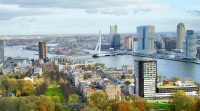
Rotterdam
Rotterdam is the outlier in this guide, and deliberately so. Its historic centre was almost entirely destroyed in the bombing of 14 May 1940, and post-war planners chose not to rebuild a facsimile. They built a modern, wide-streeted, high-rise city instead. That decision still defines the housing stock today, from mid-century reconstruction blocks to contemporary residential towers.It draws professionals in maritime, logistics, engineering and corporate roles, pulled by Europe’s largest port and the economy around it. International schooling is available, though the concentration is lower than in The Hague or the Amsterdam area. Rail links across the Randstad are strong, with Amsterdam around 43 minutes on the fastest services.
In feel, Rotterdam is bolder, more diverse and less traditionally Dutch than its neighbours. People who love it tend to love it for exactly that.
-
Haarlem
Haarlem is a compact historic city with a cobbled, canal-threaded centre and calmer family-oriented streets further out, and it is the place families most often choose specifically instead of Amsterdam. It sits close to Schiphol, Hoofddorp and the coast.The commute is why it works. Haarlem to Amsterdam Centraal takes around 15 to 16 minutes on direct services, comfortably inside the informal 30-minute benchmark, with trains running frequently through the day. You get most of Amsterdam’s access with a fraction of its intensity.
The character is often described as Amsterdam energy at arm’s length. Gabled houses, a proper market square, independent shops, and the dunes twenty minutes away. The old centre is Amsterdam in miniature, down to the narrow cobbled streets and the listed frontages.
-
Bloemendaal and Aerdenhout
Bloemendaal, which administratively includes Aerdenhout, is widely identified as the wealthiest municipality in the country, with Aerdenhout frequently cited as its wealthiest individual town. The housing is villas, former manor estates subdivided into private plots, and large detached family homes on genuinely low-density ground.It sits in the dune belt between Haarlem and the coast at Zandvoort, backing directly onto the Kennemerduinen, a protected stretch of dunes, woodland, dune lakes and grassland that is home to roughly 40% of all plant and animal species found in the Netherlands. The people who choose it are established wealth, Dutch and international both, who want space and privacy without giving up Haarlem on the doorstep or Amsterdam within reach.
Character is the whole appeal here. Wooded, coastal, quiet, and almost entirely residential.
-
Amstelveen
Immediately south of Amsterdam, Amstelveen is modern, spacious, purpose-built family housing, and one of the most internationally settled towns in the country. It is calmer and greener than central Amsterdam while remaining, in practical terms, part of it.It is the country’s most concentrated hub for Japanese residents, home to roughly 40% of the Netherlands’ Japanese expatriate population, a legacy of Japanese corporate expansion from the 1970s, with a substantial Indian community alongside.
The commute is barely a commute. Tram line 5 reaches Amsterdam Zuid in around 11 minutes, and the wider city follows from there.
-
Oegstgeest
Oegstgeest adjoins Leiden so closely as to be continuous with it, an attractive, leafy residential town that appeals to families who want Leiden’s international university city on the doorstep and a quieter address to come home to. The housing is established, comfortable and family-scaled rather than dramatic.The pull is largely academic and scientific. Leiden’s university, teaching hospital and the surrounding biotech and medical sector draw the households that end up here, and Leiden Centraal is a short cycle or drive away, with the wider Randstad from there.
In character it is a genuine alternative to Leiden for anyone who wants a garden and a quieter street without leaving the orbit of the city.
-
't Gooi: Laren, Blaricum and Naarden
The Gooi region sits east of Amsterdam, and a great deal of established Dutch wealth has lived there for well over a century. It is nicknamed, only half in jest, the Beverly Hills of the Netherlands. Laren and Blaricum are villages of large villas set among woodland and estate lanes, both grown from the nineteenth century onwards as country retreats for wealthy Amsterdam and Utrecht families once the railways made the journey practical. They are the only two villages in North Holland with a recognisable traditional village green.Naarden is something else again, and architecturally the most distinctive place in this guide. It is one of the best-preserved star-shaped fortified towns in Europe, with a seventeenth-century moated, walled centre of narrow cobbled streets inside a defensive perimeter that has not changed shape in 350 years.
Hilversum anchors the region practically and it is the centre of the Dutch broadcasting industry. Commuting works, with Hilversum to Amsterdam Centraal takes 19 minutes on the fastest services and around 28 on average, and Naarden-Bussum is around 20 minutes. That puts the region at the edge of the 30-minute benchmark rather than outside it.
The landscape is inland, not coastal, shaped by peat, small lakes, reed-lined water and long tree-lined estate lanes. It reads and feels quite different to the dune country around Bloemendaal.
-
Eindhoven
Eindhoven is the clearest technology hub in the country, and the housing follows the profile: modern apartments and family houses, more generous in space than the western Randstad, in a city that has grown around industry rather than trade.The draw is Brainport, the regional technology ecosystem built on Philips’ long presence and the companies that came out of it, ASML among them. The region’s workforce spans more than 150 nationalities, with roughly 90% of the population speaking English, which makes settling in unusually easy for a non-Randstad city. International School Eindhoven covers ages 3 to 18. Amsterdam is around an hour and a quarter by train, so this is a place to live and work rather than a commuter base, and the city has its own international airport.
Character is green, modern and practical, with industrial heritage in place of historic charm. Design and technology run through it, most visibly during Dutch Design Week.
-
Amsterdam, in Brief
Amsterdam remains the default for anyone whose career, cultural life or international network centres on the city, and with 934,374 residents at the start of 2025 it is the country’s largest by a distance.Many established families look hard at Amsterdam and then choose the ring around it. Haarlem for the historic centre at a calmer scale, Amstelveen for the schools and the space, Bloemendaal for the woodland, Wassenaar and ‘t Gooi for privacy. All of them keep the city within reach without asking a household to live inside it.
Amsterdam’s own neighbourhoods deserve more room than a section here allows, since the Grachtengordel, Oud-Zuid, De Pijp and the Amstelveen border areas are genuinely different places to live.
Our best areas to live in Amsterdam guide covers those neighbourhood by neighbourhood, and our removals to Amsterdam service page covers arranging the move itself.
Planning the Move Itself
Wherever you land on this list, the property at the other end has its own physical realities, and they are far easier to plan around than to discover on the day. Every Williams & Yates move is run by a single dedicated coordinator who surveys both addresses, in person or virtually, builds the inventory on your behalf and works out how each item gets in before anything is packed.
That planning sits alongside the things a household of this kind tends to need: an in-house crating workshop building to the individual piece rather than to a standard size, fine art and antiques handling including CITES documentation, pet relocation, vehicle transport, and FIDI/FAIM accreditation, the international removals industry’s highest standard.
When you are ready to talk about the move itself, our removals to the Netherlands service page sets out how we work, or you can arrange a tailored home survey at a time that suits you.
Arrange a Home SurveyTo book or ask us a question, call us on 0208 081 0188 or get in touch.