Grandfather Clock Removals
Grandfather clock removals sit outside the scope of a standard furniture move. A grandfather clock, called a longcase clock in the antiques trade, is the same object under two names: a weight-driven pendulum clock in a tall freestanding case, commonly standing between 1.8 and 2.4 metres. The height is the obvious difficulty and the lesser one. What sits inside the case is the reason it needs a specialist.
Williams & Yates move grandfather clocks as part of full international and UK relocations, alongside the fine art and antiques they stand beside at home. This page sits within our wider Specialist Item Removals hub.
What Makes Grandfather Clock Removals a Specialist Job
A grandfather clock, or longcase clock, needs specialist handling because its working parts are not fixed in place. The weights hang free, the pendulum hangs from a fragile steel suspension spring, and the case is tall, narrow and heavy at the top. None of it travels safely assembled.
The suspension spring is the part most people underestimate. It is a thin flat strip of spring steel, and the component in the movement most likely to fail. A UK clock repair specialist puts much of the post-move repair work they see down to this one part: a pendulum left hanging will bounce in transit and almost certainly break the suspension spring.
The case brings its own risks. Grandfather clock construction moved from oak through walnut to mahogany veneers, and fine examples carry seaweed marquetry, brass inlay or, on Continental-influenced pieces, Boulle work in tortoiseshell and brass, as set out in a London dealer’s guide to antique longcase clocks. Those veneers, the hood glass and the applied mouldings are the vulnerabilities a furniture blanket does nothing for.
A grandfather clock is really two consignments in one object: antique cabinetry and a working precision instrument. Treated as a tall wardrobe, it can arrive looking untouched. The damage surfaces weeks later, when the clock will not keep time.
How Do You Prepare a Grandfather Clock for Removals
Preparation follows the clock’s own setup sequence in reverse. No clock expert publishes a dedicated moving standard, so we’ve made our own standard based on our experience and the conversations we’ve had with experts over the years.
The weights come out first, each labelled by the position it hung in. A grandfather clock runs on two or three weights and they are not interchangeable: each drives a specific train, with the heavier weight conventionally on the striking or chiming side. Returned to the wrong line, the strike falls out of step with the time train. Taking them off is the part of the job that looks easiest from the outside, and there is a knack to doing it cleanly.
The pendulum follows, released from its suspension spring and wrapped separately. Once it is out, nothing is left inside to swing against the escapement or the crutch in transit.
The drive lines are secured next. A longcase movement runs on either chains over sprocketed wheels or gut lines over pulleys, and each takes a different method so nothing can unspool or jump its sprocket. Chime rods and hammers are padded or restrained for the same reason. They are brittle, and it takes very little movement for them to meet each other.
The hood, the removable top section that holds the dial, lifts clear once nothing inside constrains it and is packed as its own item. Below it, the movement sits on a seatboard. That board is screwed in rather than permanently fixed, so the movement can be lifted out and carried separately from the trunk where the piece warrants it.
This is a general guide, with each grandfather clock considered individually.
-
-
How Is the Case and Movement Protected in Transit
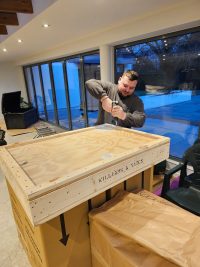
Once prepared, the clock is protected as a fine antique rather than as furniture. Case, hood, dial, pendulum and weights travel as separately packed components. The hood glass and the trunk door glazing are given particular attention, and packing materials are selected with the individual piece in mind rather than pulled from stock.
Bespoke crating is the honest answer for a tall, narrow, top-heavy object built from timber, veneer, glass and brass. Ours are made in our own crating workshop, to the clock’s measurements.
Climate is the other factor. It is the swing in relative humidity rather than the absolute level that lifts veneer and opens joints. Brass inlay makes that worse, since it expands at a different rate to the wood it sits in. On a move across different climates, it is a live consideration, and a reason a clock waiting between properties is better held in controlled fine art storage than an ordinary unit.
What Additional Requirements Apply to Moving a Longcase Clock Abroad
An antique grandfather clock crossing a border is not treated as ordinary household goods. Three questions come up more often than any others, and your coordinator works through each of them before anything is packed.
The first is declared value and cover. A clock’s insured value should rest on documented evidence, independent valuations, invoices or purchase records rather than a self-assessed figure. Cover needs to account for mechanical damage and glazing, not only the cabinet.
Customs relief is the second. For a family moving their main residence to the UK, GOV.UK’s guidance on Transfer of Residence relief allows personal and household effects to be imported free of import duties and charges. Other countries have similar schemes and your move coordinator will be able to advise you for your specific move. Transfer or residence relief is subject to conditions on how long you have owned the goods and when they arrive, with the ToR1 application approved before the consignment travels. Genuine antiques are treated differently from ordinary household goods for import VAT, and the age of the piece is central to how it is assessed. Our own explainer on Transfer of Residence relief covers the process, including the provenance documentation worth assembling early for an inherited piece.
The third is export licensing and protected materials. Cultural objects permanently leaving Great Britain can require a UK export licence, administered by Arts Council England on behalf of the Secretary of State for Culture, Media and Sport, and the requirement turns on the object’s age and value against published thresholds. A genuinely old clock signed by a known maker is a realistic candidate.
Protected materials sit alongside that as a separate question. Where a case or dial incorporates material from a protected species. The common ones that crop up are tortoiseshell inlay on Boulle-style work or a small quantity of ivory stringing, a CITES permit issued by the Animal and Plant Health Agency may be required to move it across a border. That is an independent requirement, not something a domestic registration under the Ivory Act 2018 satisfies on its own. Williams & Yates handle CITES documentation as part of our fine art and antiques work, and whether any of it touches your clock is established at survey rather than at the border.
What Happens When Your Clock Arrives
Reassembly is what clients ask about most, because the question underneath is whether the clock will run properly again. Setting a grandfather clock going is a defined process with an order to it.
The case is levelled first and, ideally, secured to the wall, since even a slight lean can let the pendulum foul the backboard and stop the clock. Shimming under the feet is the usual correction on an uneven floor.
The weights are re-hung on their labelled lines, the suspension spring guided back through the crutch, and the clock set “in beat”, so that its tick and tock fall at even intervals rather than in an uneven, galloping rhythm.
Timekeeping then settles. A pendulum’s rate responds to temperature and to the particulars of a new position. The clock is run against an accurate reference, the daily gain or loss recorded, and small adjustments made to the regulating nut until it holds. Typically a clock needs a settling period in its new home before it can be trusted to time. Your coordinator will advise on timing and on how reinstatement is arranged, much as we handle fine art installation at destination.
Why Choose Williams & Yates for Grandfather Clock Removals
You will have one dedicated move coordinator from first survey to final placement, and that same person handles the crating specification, the customs paperwork, the CITES question where it arises, and the arrangements at destination. There is no handover between departments, and you will not have to explain the clock twice. Where a household is run by a PA or household manager, we work alongside them throughout, and a single move can consolidate collections from more than one address.
Williams & Yates hold FIDI/FAIM accreditation, the international removals industry’s highest standard, and are members of BAR and IAM. We are Which? accredited. The fine art and antiques side of our work is where grandfather clocks sit, and it draws on the same in-house crating capability we use for gilt-edge mirrors and dismantled chandeliers.
If you have a grandfather clock to move, whether across the globe or down the road, the sensible starting point is a survey, in person or virtually, so it can be assessed in the room it stands in. Arrange a tailored home survey or relocation enquiry, or call us on 0208 081 0188.
Arrange A Survey-
Do You Need a Specialist to Move a Grandfather Clock?
Yes. The risk in a grandfather clock is not its weight, it is the weights, drive lines, suspension spring and chime rods inside the case. Damage to any of them is rarely visible at delivery. It surfaces when the clock is reassembled and will not run or strike correctly, by which point the cause is hard to establish.
-
Can a Grandfather Clock Be Moved Lying Down?
Not as it stands. Once the movement, pendulum and weights have been properly removed and the chains or lines secured, experienced restorers regard orientation as no longer the deciding factor, because nothing remains inside to swing or load the suspension spring. Older cases with double seatboard construction are treated more cautiously. The blanket “always upright” rule found in most guides is a simplification for clocks that have not been stripped down, and it is the right assumption for any clock not prepared by a specialist.
-
How Much Does It Cost to Move a Grandfather Clock?
It depends on the clock and the move. Preparation, the crate built to the piece, the destination and any customs, licensing or CITES requirements all bear on it, so we do not publish a rate that would mean little applied to your clock. A survey gives you a properly costed proposal, and you can request one here.
-
What Happens to My Clock When It Arrives at Its New Home?
The case is levelled and secured, the weights re-hung on their original lines, the pendulum and suspension spring reattached, and the clock set in beat so it ticks evenly. Timekeeping settles afterwards as the pendulum adjusts to its new position. In most cases some fine regulation follows, and your coordinator will advise on timing.
-
What Is the Difference Between a Grandfather Clock and a Longcase Clock?
There is none. They are the same object. “Longcase clock” is the term used in the antiques trade and by horologists, while “grandfather clock” is the common name, popularised by an 1876 song. The same clock is also called a tall-case clock, a hall clock or a floor clock.
To book or ask us a question, call us on 0208 081 0188 or get in touch.