0208 081 0188
Contact us
0208 081 0188
Contact us
Press enter to begin your search

Removals to Belgium
Williams & Yates plans and manages removals to Belgium from the UK for private families, household managers and corporate relocations. One dedicated move coordinator handles everything from the first survey to placement in your new home, whether that is an apartment in Ixelles, a townhouse in Antwerp or a coastal home in Knokke-Heist. The practical detail is set out below, from the permits your removal vehicle needs to customs relief on your household goods and the care of fine art and valued collections.
A Dedicated Move to Belgium, Not a Shared Load
Many of the options for a move to Belgium are built around shared loads or quote comparison sites. Your belongings join other people’s on a vehicle, and the date follows the route rather than your plans.
Every Williams & Yates client instead has a dedicated move coordinator, a single point of contact who plans the move around your dates and helps with the commune arrangements, customs paperwork and crews. You or your PA have one person to speak to from start to finish.
Brussels is home to the European Commission, the Council of the EU, NATO headquarters and a large diplomatic and corporate community, so many moves to Belgium are postings rather than purely private decisions. We plan EU institution and NATO postings, diplomatic assignments and corporate relocations arranged through a global mobility team with the same care as a private family move. If your career could take you elsewhere in the Benelux, our removals to the Netherlands follow the same coordinator-led approach.
Talk to us-

-
Your Move to Belgium, Managed From Start to Finish
Survey. Your move begins with a survey, in person or virtual. We assess volume, access at both ends and any items that need crating, and plan any storage at the same time.
Inventory and paperwork. We complete the inventory for you, and your coordinator prepares the customs documentation alongside the commune parking reservation and vehicle registrations.
Transport. Smaller consignments can travel on a part-load or consolidation service, while larger moves travel on a vehicle dedicated to your belongings. Our guide to moving house by sea, air or road explains the options. Road moves typically cross the Channel between Folkestone and Calais on LeShuttle Freight, a crossing of around 35 minutes, or by ferry, the same crossings used for our removals to France.
Storage. If your dates do not line up, we offer high-security storage in London and Dunstable, as well as storage at your destination.
Delivery and placement. On arrival, you can choose a debris clear unpack, where boxes are emptied onto clear surfaces for you to arrange, or a full white-glove service, where everything is unpacked, put away and beds made up so you can sleep there that night.
Many of our clients’ moves are run day to day by a PA or household manager, and we work alongside them throughout. A single move can also bring together more than one collection address, such as a main residence and a second home.
When you are ready, arrange a tailored home survey with a FIDI/FAIM accredited mover, and your coordinator will take it from there.
Contact us
-
Moving to Brussels or Antwerp: What the Local Rules Mean for Your Move
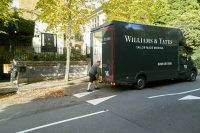
To park and unload a removal vehicle on a street in central Brussels or Antwerp, you need a temporary parking reservation from the local commune, booked in advance of moving day. The commune authorises the space and puts up no-parking signs, so the vehicle can load close to your door.
A commune (gemeente in Dutch) is Belgium’s local municipality, responsible for matters such as residents’ registration, parking and the use of public streets. Brussels alone has 19 communes, and each one sets its own procedures and fees.
Parking and Loading Reservations
In Brussels, the process starts with a permit to occupy the public road through the regional Osiris platform, after which the commune arranges the signage. The City of Brussels guidance on no-parking signs asks for sign requests at least ten working days ahead. Antwerp’s temporary parking ban service works on a standard notice period of five working days.
Notice periods and fees vary by commune, so your coordinator will build the reservation into the plan and advise on timing once your delivery address is confirmed.
Apartment and Townhouse Access
Central Brussels and Antwerp have narrow streets, tall older townhouses with tight stairwells, and apartment buildings with compact lifts. At the survey, we note street width, lift size, stair turns and where the vehicle can stand, so the crew arrives with the right equipment.
Where a large item will not fit the stairs or lift, we can hoist it through a window using an external lift.
Registering With Your Commune
After you arrive in Belgium, you need to register with the commune where you live. The commune records your address and carries out a residence check to confirm you live there. The deadline and documents depend on your nationality, your residence status and the length of your stay.
Belgium’s Federal Public Service Home Affairs sets out the reporting obligations for each category of stay, and some deadlines fall within days of arrival. Registration is yours to complete, but your coordinator will plan delivery around it, so the documents you need are to hand rather than packed on the vehicle.
Staff accredited to EU institutions, NATO or diplomatic missions often follow separate protocol arrangements. The FPS Foreign Affairs protocol guide on immunities and privileges covers special identity cards and fiscal privileges, and your employer’s relocation team will usually confirm which apply to you.
-
Customs and Duty-Free Relief for Your Move to Belgium
Since Brexit, the UK sits outside the EU customs territory, so household goods moving to Belgium from the UK are treated as imports. Belgium offers relief from import duties for people transferring their normal residence from a non-EU country, administered by Belgian Customs under FPS Finance.
According to FPS Finance guidance on moving from a non-EU country to Belgium, the main conditions are:
- You have lived outside the EU customs territory for at least 12 continuous months before the move.
- Your goods have been in your possession and used at your former home for at least six months, and will be used for the same purpose in Belgium.
- The goods are imported within 12 months of establishing your residence in Belgium. They can arrive earlier if you commit to taking up residence within six months, in which case a security is required.
- For one year after import, the goods cannot be lent, pledged, rented out or transferred without notifying customs in advance.
Motor vehicles, larger motorbikes, caravans and boats need separate approval from the regional customs director. FPS Finance also lists the exclusions: alcoholic drinks, tobacco, company vehicles and professional equipment do not qualify for relief. Duties will therefore apply to a wine collection, and our page on moving wine collections explains how we transport and declare it.
This Belgian relief is separate from HMRC’s Transfer of Residence relief. The UK’s ToR1 process governs goods coming into the UK, so it applies if you later move back, not when you leave. Our guide to UK Transfer of Residence relief and the ToR1 process covers that return journey.
Fine Art, Antiques and Valued Collections on the Move to Belgium
Homes across Brussels, Antwerp and Ghent often hold collections built over a career spent between postings. Clients often tell us they chose us because we make our own crates.
Paintings, sculptures and statues are measured at the survey, and each crate is built to specification in our in-house crating workshop. Crates for international consignments use ISPM 15 compliant timber, the phytosanitary standard for wood packaging. At your Belgian home, we uncrate the pieces in the rooms you choose and photograph them as they come out, so you have a record that everything arrived as it left.
We also handle CITES documentation for antiques and pieces made from protected species. If parts of your collection need to wait in the UK, our fine art storage keeps them in a monitored, climate-controlled environment until the Belgian property is ready.
FAQs
-
What Does a Move to Belgium With Williams & Yates Involve?
Each move to Belgium is planned and quoted individually after a survey. The cost reflects the volume of your belongings, access at both properties, whether you use a part-load or a dedicated vehicle, any crating for fine art, and storage. One dedicated coordinator manages the whole move.
-
Do I Need to Pay Import Duty on My Belongings When Moving to Belgium?
In most cases, used household goods can enter Belgium free of import duty under Belgian transfer of residence relief. You must have lived outside the EU for at least 12 months, owned and used the goods for at least six months, and import them within 12 months of settling. Alcohol, tobacco, company vehicles and professional equipment are excluded.
-
Do I Need to Register When I Arrive in Belgium?
Yes. You register with the commune where you live, which then carries out a residence check at your address. The deadline and documents depend on your nationality, residence status and length of stay. Some deadlines fall within days of arrival, so it is worth planning before you move.
-
How Long Does a Move From the UK to Belgium Take?
It depends on the volume of your belongings, the transport option, any crating and the parking notice each commune needs. The Channel crossing is short, and your coordinator will advise on timing once your survey is complete.


By far the best removals service I have received, ever. Thank you so much with our recent move, especially when we moved the goal posts last minute.
Mr Thatcher
Book your survey
To book or ask us a question, call us on 0208 081 0188 or get in touch.