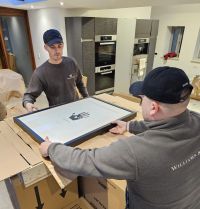
For most households, a move to Switzerland is a question of careful packing, documentation, and well-managed logistics. For those whose homes contain fine art, antiques, sculptures, wine collections, or other high-value and irreplaceable possessions, the process is considerably more involved. Swiss import regulations, CITES wildlife protection requirements, the physical demands of an Alpine transit, and the specialist requirements of bespoke crating all introduce a level of complexity that requires dedicated expertise at every stage.
This guide covers the main considerations: how collections are transported from the UK to Switzerland by road and by air, what Swiss customs duties and VAT apply on arrival, the CITES documentation required for certain materials, and how specialist packing and crating protects individual pieces in transit.
Road is the standard method for most collection moves from the UK to Switzerland, and for good reason. A dedicated, climate-controlled vehicle, loaded and sealed under supervision and driven directly to the Swiss destination, provides the simplest chain of custody and the fewest handling points between packing and delivery. Door-to-door transit from the UK typically takes a few days, depending on the collection’s scale and destination canton.
Vehicles used for fine art transit are equipped with air suspension to absorb vibration on the road and in the Alpine approaches, and with active temperature management systems to maintain stable conditions throughout the journey. For paintings on canvas, panel paintings, lacquered furniture, gilded frames, ceramics, and works on paper, humidity and temperature fluctuation in transit is a genuine risk. A correctly specified vehicle manages those conditions consistently throughout the full journey, not only in ideal circumstances but across the range of weather and seasonal conditions encountered on a UK to Switzerland crossing.
Road transport carries none of the size or weight restrictions that apply in air freight, which makes it the natural choice for large-format works, heavy sculptures, oversized furniture, or any collection where individual pieces are not easily broken into smaller consignments. For families consolidating a collection move with a full household relocation, road allows the collection to travel either within the main consignment or in a dedicated vehicle running alongside it, under the same documentation and coordinator management throughout.
Customs clearance at the Swiss border is handled by the move coordinator as part of the standard process. All documentation is prepared and submitted in advance so that nothing is held or delayed at the crossing.
Air freight is the appropriate choice when speed matters most, when a single high-value piece needs the shortest possible time in transit, or when a collection is being moved from a location where road logistics are more complex. Geneva Airport and Zurich Airport both handle specialist art freight, and Geneva in particular has established procedures for high-value consignments that feed directly into the Geneva Freeport’s storage and customs infrastructure. Where a piece is being placed directly into freeport storage, air freight and Freeport delivery can be coordinated as a single chain, managed by your coordinator from departure through to confirmed receipt.
The packing requirements for air freight differ from those for road. Atmospheric pressure changes in an aircraft hold, combined with a different vibration profile, require crating materials and construction methods specified for those conditions. Pieces that are sensitive to pressure or that have delicate or unstable surfaces need crating reviewed specifically for the air environment, not simply adapted from a road transit specification. At Williams & Yates your coordinator will manage the build accordingly.
CITES documentation requirements apply equally to air and road shipments. The mode of transport has no bearing on what permits are needed or how they are obtained.
For families moving to Switzerland and importing a collection as personal effects, the starting point is the change of residence provision. The Swiss Federal Office for Customs and Border Security (BAZG) permits the duty-free, VAT-exempt import of personal effects, including fine art and antiques, on establishing Swiss residence, provided the items have been owned and in personal use for at least six months before the move, are not sold within one year of import, and the relevant documentation is complete before the consignment reaches the border. For most families relocating a collection that has been part of the household for years, this provision covers the large majority of what they are moving.
For items that fall outside the change of residence exemption, pieces acquired shortly before the move, or a collection arriving separately at a later date, the Swiss customs tariff is generally favourable for art and antiques. Original works of art including paintings, drawings, sculptures, and original prints attract 0% customs duty under the Swiss tariff schedule, as do antiques demonstrably over 100 years old. VAT at the applicable rate applies to imports that do not qualify for the personal effects exemption, and the specifics depend on how the import is structured and the nature of the items involved. For any collection with pieces falling outside the straightforward change of residence scenario, specialist customs advice is worth taking before the move date is fixed.
The Geneva Freeport is a further option for collectors who are not importing a collection into personal use immediately. Goods held in the Freeport are under customs suspension: import duties and VAT are deferred for as long as the items remain in storage. It is a well-established arrangement used by major collectors, institutions, and auction houses, and allows pieces to be assessed, loaned, or transferred in ownership without triggering an immediate import duty event. For significant collections where part of the holding is not yet destined for a specific property, the Freeport can be a practical staging point.
Certain objects commonly found in private collections are subject to CITES controls, the Convention on International Trade in Endangered Species, which governs the movement of items containing materials derived from protected species. Switzerland enforces CITES at its borders, and all documentation must be in order before the consignment leaves the UK.
The materials most frequently encountered are elephant ivory, which appears in antique furniture inlays, piano keys, silverware handles, and decorative objects; tortoiseshell from the hawksbill turtle, found in boxes, frames, and furniture inlays; tropical hardwoods including rosewood and ebony, common in antique furniture and musical instruments; and coral, which appears in decorative pieces and jewellery. These materials turn up in collections far more often than their owners anticipate, particularly in pieces held for decades without the question having been raised before.
To export CITES-listed items from the UK, a permit from APHA (Animal and Plant Health Agency) is required. For items made before 3 March 1973, a pre-Convention certificate is also required. Both are confirmed in GOV.UK guidance on CITES imports and exports. Swiss import documentation is required from BAFU/OFEV, the Federal Office for the Environment. Both sets of permits must be in place before departure. From initial collection review to permits confirmed, the process typically takes two to three months. Your coordinator manages this throughout, working with the relevant authorities on both sides.
Fine art and antiques need packing that goes well beyond what a general removal company can offer. We run an in-house crating workshop, building bespoke crates designed around the specific requirements of each individual piece, its dimensions, material sensitivity, structural fragility, and the conditions of its transit method.
A large oil painting on canvas, a bronze sculpture, a piece of Chinese porcelain, and an 18th-century French commode each present entirely different problems. The crate is built for the specific piece: internal suspension for fragile canvases, foam profiling for sculptures with complex surfaces, acid-free materials throughout for works on paper and panel, and vapour barriers where climate sensitivity requires them.
Every crate is documented as part of the consignment record, supporting both Swiss customs clearance and the insurance position.
For musical instruments containing CITES-relevant materials, documentation requirements must be confirmed before packing begins. For wine collections, temperature-controlled transport is required throughout, coordinated alongside the customs import process. For classic or high-value vehicles, the practicalities are assessed case by case and your coordinator will advise on the options. Whatever the nature of your collection, the earlier the assessment begins the more time there is to plan for the specific requirements of each category.
Fine art moving to Switzerland should be covered by a specialist all-risk transit policy, not a standard household contents extension. Cover should be in place before packing begins, on an agreed-value basis using a current independent appraisal for each significant piece. This is the standard used by museums and major collectors, and it is the appropriate baseline for any collection of meaningful value. Your coordinator can advise on documentation requirements and connect you with appropriate specialist insurers as part of the planning process
If your move includes a collection of any kind, paintings, sculptures, antique furniture, instruments, wine, or other high-value possessions, raise it at the very start of planning. The lead time for documentation and crating is longer than a standard household move, and the earlier the process begins, the more options are available on timing, transport method, and how different parts of the collection are handled.
To discuss your collection and what your move to Switzerland involves, contact the Williams & Yates team.
Switzerland has long attracted those looking for something genuinely difficult to find elsewhere: political stability, exceptional infrastructure, a strong international community, and a quality of life that is hard to argue with. For UK nationals considering a move, it remains one of the most compelling destinations in Europe, even as the process of relocating there has changed considerably since Brexit.
This guide covers what you will need to think about when planning a move from the UK: residence permits and taxation, choosing where to live, arranging healthcare, and managing the logistics of the relocation itself. Switzerland rewards careful preparation, and the more thoroughly you plan, the more straightforward the transition tends to be.
At Williams & Yates, we handle relocations to Switzerland regularly. Our dedicated move coordinator model means one person manages your entire move from first conversation to final delivery, coordinating every element so you do not have to.
Switzerland’s reputation for stability is not simply a cliché. It is a country with a long record of political neutrality, a robust federal structure, and institutions that function reliably. For those moving with family, this translates into a genuine sense of security, both day-to-day and in longer-term planning.
The quality of life is consistently ranked among the highest in the world. Public transport is punctual and extensive. The natural environment, from Lake Geneva to the alpine landscapes beyond the cities, is part of daily life rather than a weekend destination. Crime rates are low, healthcare is outstanding, and the infrastructure simply works.
The international community is large and well-established, particularly in Zurich, Geneva, and Basel. English is widely spoken in business and expat circles, which smooths the practical transition considerably. Both Zurich and Geneva have dense networks of international schools, professional communities, and cultural institutions that make it straightforward to build a settled life from the outset.
Since the UK left the European Union, UK nationals are treated as third-country nationals in Switzerland. The free movement rules that previously applied no longer do, and a permit is required before you can live and work there.
There are three main permit categories you are likely to encounter. The L permit is a short-term residence permit, typically granted for stays of up to twelve months and often tied to a specific employment contract.
The B permit is the standard residence permit for those planning a longer stay and it is granted for a renewable period of up to five years and, in most cases, linked to employment or to demonstrating sufficient financial means.
The C permit is permanent residence, available in most cases after ten years of continuous residence for UK nationals as third-country nationals.
A specific quota system applies to UK nationals. Each year, 1,400 L permits and 2,100 B permits are allocated, released quarterly (Swiss State Secretariat for Migration). In practice, these quotas have been substantially undersubscribed: as of end-2025, the majority of allocated places remained unused.
For financially independent individuals who are not planning to work in Switzerland, a separate pathway exists. The permit is based on demonstrating that you have the means to support yourself without employment. For those considering the lump-sum tax arrangement (discussed below), the permit process runs alongside the cantonal tax negotiation and typically involves close coordination with a specialist adviser.
Requirements vary depending on your circumstances, and the process involves both canton-level administration and federal rules. Taking advice from a Swiss immigration specialist early in the planning process is strongly recommended.
Swiss Visas and Residence Permits for UK NationalsSwitzerland has one of the highest costs of living in the world. That is straightforward, and there is little to be gained by soft-pedalling it. The more useful observation is that purchasing power at senior professional and high-net-worth level tends to be strong: Switzerland also has some of the highest salaries in the world, and its infrastructure and services are commensurate with what you pay for them.
Housing is typically the largest single expense. Renting is the norm on arrival, and even among long-term residents, homeownership is less prevalent than in the UK, partly because property prices are high and partly because non-residents face purchasing restrictions in certain cantons. A well-appointed apartment in Zurich or Geneva will comfortably exceed CHF 5,000 per month for a family home of meaningful size.
Healthcare insurance premiums are a fixed and significant cost every resident must factor in. In 2025, average monthly premiums reached CHF 378.70 per person (Expatis, 2025), and that figure varies depending on your canton of residence, your chosen insurer, and the deductible level you select. Supplementary private cover, which is standard at senior professional level, adds to this further.
International school fees, where applicable, are a substantial commitment. Annual fees can run from CHF 15,000 at the lower end to well over CHF 100,000 per year at leading secondary schools (Relofinder, 2026).
Everyday grocery costs run approximately 40 to 60 per cent higher than equivalent UK spending, though restaurant and service quality is correspondingly high.
Cost of Living in SwitzerlandCanton choice matters more in Switzerland than city choice does in most other countries, because tax rates, permit conditions, and school availability vary significantly across cantons.
Zurich is Switzerland’s financial and business capital. It has the largest and most developed international business community, a strong cluster of international schools, and an infrastructure that makes it one of the most functional cities in the world. It is also the most expensive canton. Zurich abolished lump-sum taxation in 2009, which is worth noting for non-employed financially independent residents.
Geneva is the de facto diplomatic capital of Europe, home to a concentration of international organisations, NGOs, and multinational headquarters. The art market is significant, and Geneva is one of the world’s leading centres for fine art and antiquities. Its proximity to France gives it a broader lifestyle geography. Vaud and the lake towns of Lausanne and Montreux offer similar lakeside living with slightly different character and a somewhat calmer pace.
Zug deserves particular attention for those who are not wedded to a major city. It is a small, well-appointed canton with the lowest cantonal tax rates in Switzerland, a strong international business community, and very good connections to Zurich. For families and individuals where tax efficiency is a material consideration, Zug is consistently a starting point for conversation.
Basel sits at the intersection of Switzerland, France, and Germany, with a cultural depth that belies its size. It hosts Art Basel, has outstanding museums, and a well-established international community, particularly in the pharmaceutical and life sciences sector.
Where to Live in SwitzerlandSwitzerland operates a mandatory health insurance model. Every resident must take out basic health insurance under the Federal Health Insurance Act (KVG/LAMal) within three months of establishing residence (Swiss Federal Office of Public Health). Coverage is retroactive to your arrival date if you register within the deadline, which means that any medical costs incurred in the interim are covered once insurance is in place.
Insurers are required by law to accept all applicants regardless of age or existing health conditions. There is no underwriting on the basic cover. The basic package is standardised across insurers; what varies is the premium level, the deductible you choose, and the service model.
Supplementary private insurance (VVG/LCA) is the norm at senior professional and high-net-worth level. This covers private wards, specialist access without referral, and a broader range of treatments and providers. It is worth arranging this alongside your basic insurance rather than as an afterthought. Most international insurers can structure a policy that bridges your existing UK private medical cover with Swiss requirements.
If you are visiting Switzerland before your move, it is worth noting that the UK Global Health Insurance Card (GHIC) does provide access to state-provided healthcare on a temporary basis (NHS Business Services Authority). Once you establish Swiss residence, however, that no longer applies to you as a resident, and your mandatory KVG/LAMal insurance takes over entirely.
Health Insurance in SwitzerlandSwitzerland’s tax system operates at three levels: federal, cantonal, and communal. Where you choose to live within Switzerland has a direct and material bearing on your overall tax position, sometimes dramatically so.
For employed individuals, income tax is assessed across all three levels, and the effective rate varies considerably depending on your canton and commune of residence. Zug is widely known for having the lowest cantonal rates in Switzerland, which is a significant reason for its popularity among internationally mobile professionals.
For non-employed, financially independent foreign nationals, the lump-sum tax regime (forfait fiscal) is an arrangement worth understanding carefully. Under this system, tax is calculated on annual worldwide living expenses rather than worldwide income and assets. The federal minimum assessment base is CHF 435,000 (Swiss Federal Finance Department, 2026), and cantons apply their own minimums, which can be higher. Zug, Geneva, Vaud, and several other cantons retain this arrangement; Zurich and a small number of others have abolished it.
The lump-sum regime is particularly relevant for those who derive income from investments, trusts, or business interests outside Switzerland and do not intend to work there. It provides a high degree of tax certainty, and the permit process for financially independent residents often runs in parallel with the cantonal negotiation. Engaging a Swiss tax adviser before selecting your canton is an important early step.
Switzerland and the UK have a double taxation agreement in place, which governs how various income streams are treated across both jurisdictions. Taking qualified, Switzerland-specific advice before you move, not after, is the right approach.
Tax in Switzerland for UK Expats: What You Need to KnowFamilies relocating to Switzerland frequently opt for international schools, particularly where children are already established in a curriculum, whether IB, British, or American, and continuity of education is a priority. The international school network in Switzerland is among the strongest in the world, with a particularly high concentration in Geneva, Zurich, Lausanne, and Zug.
Families typically choose international schools for curriculum continuity, English-medium education, and a peer group that reflects the international nature of expat life. For children joining mid-way through a school year or at a critical examination stage, finding the right school quickly matters considerably.
Places at leading international schools are competitive. Some schools in Geneva and Zurich carry waiting lists of two to three years. If you have a preferred school in mind, contacting it at the very beginning of your planning process, well before you have a confirmed move date, is strongly advisable. Your move coordinator can help you sequence this alongside the other threads of your relocation so that school enquiries and housing decisions are aligned from the start.
Fees range from approximately CHF 15,000 per year for younger children to well over CHF 100,000 per year at leading secondary schools (Relofinder, 2026). Most international schools also charge registration and enrolment fees on top of annual tuition.
International Schools in Switzerland: A Guide for UK FamiliesA move to Switzerland rewards early planning. The permit process, school enquiries, housing search, and shipping logistics all carry lead times that can compress awkwardly if left too late. Beginning your planning well before your target arrival date means each element can progress at its own pace without creating bottlenecks.
On the customs side, household goods imported to Switzerland when establishing residence are admitted duty-free, provided they have been in your possession and in use for at least six months prior to your official change of residence date. They cannot be sold within one year of import, and the correct documentation must be in place before the consignment arrives. If your residence permit is not yet finalised, an employment contract or letter from a Swiss employer can serve as interim documentation (Swiss Federal Office for Customs and Border Security). Your move coordinator will manage the preparation of all shipping and customs documentation as part of the removal.
Williams & Yates is FIDI/FAIM accredited, the international removals industry’s highest standard, and works to the same level on every move regardless of scale. The FAIM quality standard covers the entire removal process from packing through to delivery, and it is the benchmark that major corporate global mobility programmes specify when choosing a relocation partner.
Vehicle transport and pet relocation can be incorporated within a managed move where required. Both involve their own documentation requirements, and planning them alongside your household goods removal tends to produce a more joined-up result.
For a sense of what a managed removal to Switzerland involves, our removals to Switzerland page provides an overview of the service.
Planning Your Move to Switzerland from the UKFor those moving fine art, antiques, or collections of significant value, Switzerland requires a level of preparation that goes beyond a standard removal. The country is one of the world’s leading art market centres, Geneva in particular, and the customs and import framework reflects that.
The most important area to address early is CITES documentation. The Convention on International Trade in Endangered Species governs the movement of items made from or incorporating protected species materials, including ivory, certain tropical timbers, tortoiseshell, and coral. These requirements apply to personal effects as well as commercial transactions. Antique ivory, even when demonstrably over 100 years old, requires a CITES pre-Convention certificate obtained before the item leaves the UK (GOV.UK CITES guidance). Both UK export documentation and Swiss import documentation are required. This is not a process that can be started at short notice, and attempting to move such items without the correct paperwork risks confiscation.
Williams & Yates has specialist knowledge of both UK export and Swiss import requirements for fine art and high-value collections. Our in-house custom crating workshop builds crates to specification for individual pieces, which matters considerably for large-format paintings, sculpture, fragile ceramics, and items with unusual dimensions. For collections that include items under CITES, we manage the documentation process as part of the move, coordinating with APHA and Swiss customs on your behalf.
Geneva’s significance as a global art market means that incoming consignments of fine art are subject to close scrutiny, and the standard of documentation expected is high. Planning the fine art element of your move alongside the broader removal, rather than as a separate afterthought, consistently produces the smoothest outcome.
Fine Art Transport to SwitzerlandMoving to Switzerland involves more moving parts than most international relocations. The permit process, tax position, school places, housing, and the logistics of the physical move all carry their own timelines and dependencies. They are best managed as a coherent whole rather than as a series of separate tasks.
That is precisely what a dedicated move coordinator at Williams & Yates provides. From your first conversation through to the point at which you are settled in your new home, one person holds all the threads, keeps every element moving forward, and removes the coordination burden from you entirely. If you would like to discuss your relocation to Switzerland, we would be glad to arrange a tailored consultation and home survey as a starting point.
Schooling is usually the first thing UK families ask about when a Switzerland move starts to look serious, and rightly so. Swiss state schools are good, genuinely good, but they teach in the cantonal language. German, French, Italian, depending on the canton. For a child arriving mid-education with none of that, immersion is an option. It is also a significant undertaking, and how well it goes depends a great deal on the child.
International schools solve the immediate problem: English instruction, a familiar curriculum, and a cohort of children who have all just moved somewhere new. The pastoral support matters too. Schools that deal with expat families regularly are much better placed to support a transition than a local state school would be.
The complication is that the best schools are over-subscribed, often by a considerable margin. Waiting lists at the leading Geneva and Zurich institutions can run two to three years. School planning cannot wait until everything else is in place.
Switzerland’s public schools work well. Small classes, solid teaching, good outcomes. For younger children with time to pick up a language, and families who plan to stay long term, the state system is worth considering.
For most UK families relocating with school-age children, the language gap is too wide. A child with no German or French will need eighteen months or more, in many cases, before they can follow lessons comfortably. That is a long time to be behind. International schools remove the barrier. English from day one, a curriculum that picks up broadly where the last school left off, and classmates in the same position.
The International Baccalaureate Organisation framework is the most common across Swiss international schools. It covers three programmes: the Primary Years Programme (PYP) through primary, the Middle Years Programme (MYP) through early secondary, and the Diploma Programme (DP) at the end of school. UK universities know the DP well.
Some schools run a British curriculum pathway, GCSEs, and A levels, which matters if there is any chance of a return to the UK or a UK university application later. American curriculum schools exist in Geneva and Zurich. A number of schools offer more than one pathway, which is useful if plans are still forming.
Geneva has more international schools per square kilometre than anywhere else in Switzerland. That reflects its history as a base for international organisations and diplomatic postings, and it means families typically have more than one serious option to consider.
Ecolint (The International School of Geneva) is one of the oldest and largest IB schools in the world, with multiple campuses in and around the city. The International School of Geneva (ISG) is a separate institution, equally well established. Despite the range of options, demand at the most popular schools consistently outpaces supply. Waiting lists can extend two to three years. Families who wait until a move is confirmed before making contact will often find they have missed their window.
Zurich International School (ZIS) is the dominant option, with several campuses across the region and IB throughout. It is well regarded and draws a genuinely international cohort. The International Community School (ICS) is another city option. For primary-age children specifically, Zurich English Junior School (ZEJS) offers English-medium education through those early years.
Provision is strong. It is slightly less concentrated than Geneva, but Zurich families are not short of options. The same timing point holds: ZIS maintains waiting lists, and early contact is worth making before a firm move date exists.
Zug is smaller, and its school provision is more limited. Most families relocating there look at a combination of local schools and Zurich, which is close enough to make daily commuting workable.
Institut Montana Zugerberg is the main local option: IB programmes, a boarding structure, and a campus on the hillside above the town. It suits families who want something smaller, or who are open to boarding. For everything else, Zug’s central position in the country makes Zurich’s schools accessible in a way that would not be true from further afield.
The International School of Lausanne (ISL) is the main anchor for the region, offering IB programmes and a strong reputation among expat families across the lake area. ENSR provides a French-medium IB alternative for families where French-language schooling is a deliberate choice rather than a default.
For families considering boarding, Institut Le Rosey near Rolle, between Geneva and Lausanne, is in a category of its own. Fees reflect that. Lausanne’s proximity to Geneva means families in this part of Switzerland have access to a wider school network than the canton alone would suggest.
Fees vary quite a bit. Annual tuition runs from around CHF 15,000 at entry level to well over CHF 100,000 per year at leading secondary and boarding schools, according to the Relofinder cost of living guide 2026. For a family with two or more children in secondary education, schooling alone is a significant budget line.
Schools typically ask for financial documentation as part of the admissions process. On top of tuition, registration fees, uniforms, school trips, and boarding costs all add up. Getting a full picture of the real annual cost early in the planning process is worth doing, it affects how the rest of the relocation budget is structured.
Two to three years is a realistic waiting time at the most oversubscribed schools in Geneva and Zurich. Families who contact schools early are in a meaningfully different position from those who start the process after the relocation decision is made.
Some schools hold shadow lists or informal expressions of interest ahead of formal applications. It is always worth making contact at the earliest possible stage, even if the timeline is provisional. School availability can genuinely influence where in Switzerland a family decides to base themselves. If a particular school is the priority, understanding the admissions picture before committing to a canton is sensible.
School registration and relocation logistics need to run alongside each other, not one after the other. Families who sort the move first and school enquiries second often find that the waiting list problem was avoidable.
For the broader planning picture, our guide to moving to Switzerland from the UK covers the full timeline. Where to live in Switzerland covers how canton choice affects day-to-day life, including school access. The cost of living guide covers the wider financial picture.
For families ready to think about the move itself, our removals to Switzerland page explains how we work.
Switzerland runs a private healthcare system, and taking out insurance is not optional once you are a resident. The obligation starts from the day you arrive, not from when you get around to it. You have 90 days to register, and that window exists to give you time to choose your insurer, not to put the decision off.
This guide covers how the system is structured, what you are required to arrange, what it costs, and how to get registered correctly.
The system has two layers, and understanding both matters before you choose your cover.
The basic statutory layer is known as KVG in German-speaking cantons (Krankenversicherungsgesetz) and LAMal in French and Italian-speaking cantons (Loi sur l’assurance-maladie). Every resident is required to hold it, regardless of nationality, age, or health history. Every approved insurer must accept every applicant. There is no medical underwriting at this level.
Above that sits supplementary private insurance, regulated under VVG or LCA in French. This is optional. It is where you extend your cover beyond the statutory minimum, the type of hospital room, whether you can see a specialist without a referral, and which treatments and therapies are included.
You have 90 days from registering your Swiss residence to arrange your KVG/LAMal insurance, according to the Swiss Federal Office of Public Health (FOPH/BAG). If you register within that window, cover is backdated to your arrival date with no gap.
The benefits included in basic cover are set by federal law and do not vary between insurers. They include GP visits, specialist consultations, hospital treatment in a shared ward, emergency care, maternity, and essential prescribed medicines. Because the benefit set is fixed, the practical differences between providers come down to premium level, franchise options, and how reliably they administer policies.
When you take out your KVG/LAMal policy, you choose an annual franchise, the amount you pay out of pocket before your insurer contributes anything. The options are CHF 300, 500, 1,000, 1,500, 2,000, or 2,500 per year, as set by the Swiss Federal Office of Public Health (BAG). CHF 300 is the minimum. Choose a higher franchise and your monthly premium falls.
Once you have met your franchise for the year, a 10% co-payment (Selbstbehalt) applies to further costs, capped at CHF 700 for adults and CHF 350 for children. After that cap, the insurer covers the full cost of basic treatment. The choice is a straightforward financial trade-off: a high franchise makes sense if your health use is likely to be low; a low franchise gives you more predictable costs if it is not.
Premiums depend on your canton, age, chosen franchise, and insurer. The average monthly premium in 2025 reached CHF 378.70, up around 6% on the previous year, according to Expatis cost of living data. Cantons like Geneva and Basel sit above the national average; some rural cantons are lower.
Beyond the statutory minimum, VVG insurance lets you shape your cover to suit how you want to use healthcare in Switzerland. That means private or semi-private hospital rooms, direct access to specialists without a GP referral, private clinic networks, dental treatment, and alternative therapies not covered under KVG/LAMal.
For those relocating at a premium level, comprehensive supplementary cover is the norm rather than the exception. Unlike basic insurance, VVG policies are individually underwritten. Insurers can decline applications or apply additional premiums based on health history, so it pays to arrange supplementary cover early, ideally before your move date.
This point is worth addressing directly, because a lot of content on the subject handles it incorrectly.
Your Global Health Insurance Card (GHIC) is valid in Switzerland for temporary visits. According to NHS Business Services Authority guidance on the GHIC, it gives you access to state-provided healthcare there on the same terms as a local resident while you are visiting.
Once you establish Swiss residence, however, that no longer applies. At the point of residency, you are subject to the mandatory KVG/LAMal requirement. The GHIC is not a substitute for Swiss health insurance, and it cannot be used to bridge the gap while you sort your policy. The 90-day registration window is time to act.
The two tools most commonly used to compare KVG/LAMal providers are Comparis (comparis.ch) and the official federal comparison tool, Priminfo (priminfo.admin.ch). Both filter by canton, age, and franchise level so you can compare approved insurers and their current premiums side by side. Once you have made a decision, you apply directly with the insurer.
The documents you will typically need are your residency documentation, your commune registration (Anmeldung), and your passport. It is one of those things that goes considerably more smoothly when it is planned before you land.
Health insurance is among the first things to arrange after arriving in Switzerland. Getting it right from the start means one less thing to untangle during the early weeks of settling in. If you are planning a relocation and would like to discuss how we handle the coordination, get in touch to arrange a consultation.
Our Moving to Switzerland from the UK: A Complete Guide and Cost of Living in Switzerland for UK Expats covers the broader picture if you are still in the planning stages.
Switzerland is expensive. Not by a small margin. Across housing, healthcare, groceries, and schooling, costs run materially higher than the UK on most counts, and significantly higher than much of continental Europe. Understanding that clearly before you move is worth doing.
What the headline figures do not capture is what you are actually buying. Switzerland has one of the highest standards of living in the world: low crime, reliable public infrastructure, a healthcare system that functions, and schools with genuine international standing. For families relocating from London or the Home Counties, the overall comparison is considerably closer than most people assume before they look at the numbers in detail.
This guide sets out the main cost categories with figures grounded in current data, so you can plan with a realistic picture of what life in Switzerland actually costs.
Most UK expats rent when they first arrive, and this is largely by necessity. Switzerland’s Lex Koller legislation restricts residential property purchases by non-EU/EFTA nationals. Without a qualifying Swiss residence permit, typically a C permit or a well-established B permit, purchasing residential property is generally not permitted in the early years of residence. Renting is the practical starting point for most new arrivals, and in many cantons it remains the norm even for long-term residents.
Rental costs vary considerably by canton and location. In Zurich, a three or four-bedroom family apartment in a well-regarded district typically starts from CHF 4,000 per month. The most sought-after areas, Seefeld and Enge in the city, and the lakeside suburbs of Küsnacht, Zollikon, and Thalwil on the eastern shore, known informally as the Gold Coast, command CHF 6,000 to CHF 9,000 for premium family properties. These villages combine proximity to Zurich’s business districts with the space and environment that relocating families tend to look for, and demand from the international community keeps prices firm.
Geneva is broadly comparable. The most desirable residential neighbourhoods are on the left bank: Champel, Florissant, and Cologny attract the diplomatic and private banking community and reflect that in their rents. The right bank and inner suburbs such as Carouge offer more range, though remain expensive by any European measure. A four-bedroom family house in Cologny will typically rent for CHF 6,000 to CHF 10,000 per month.
Zug is notably smaller than Zurich or Geneva but has attracted a significant international business community partly because of its canton’s low tax rates. Rents are lower than Zurich in absolute terms, though not dramatically so given demand. Lausanne and Basel both offer more range at a slightly lower price point, which for some families represents a worthwhile trade-off against slightly longer commutes into the main financial centres.
The rental process also works differently from the UK. Swiss landlords routinely run credit checks and request employer references or proof of income. A security deposit of two or three months’ rent is standard, held in a blocked account for the duration of the tenancy rather than held by the landlord. Your coordinator can help you understand what to prepare and advise on timing so that accommodation is secured before your move date.
Health insurance is compulsory. Every resident must register for basic Swiss cover within 90 days of arrival, and cover is retroactive to the date of arrival provided registration falls within that window. The system is entirely private; premiums are paid individually by each household rather than deducted from salary, and there is no public opt-out at the basic level.
The basic statutory insurance operates under the KVG framework in German-speaking cantons and the LAMal in French-speaking ones. According to Expatis cost of living data, the average monthly premium for basic coverage reached CHF 378.70 in 2025, up around 6% year on year. In practice, what you pay depends on your canton, your insurer, your age, and the deductible level you choose.
The deductible is called the franchise. The minimum is CHF 300 per year. Choosing a higher franchise, such as CHF 1,500 or CHF 2,500, reduces your monthly premium considerably but means you cover more of any treatment costs out of pocket before the insurer contributes. For a healthy adult with few medical requirements, a higher franchise is often the more economical choice. For those with ongoing health needs, a lower franchise typically makes more financial sense. The Swiss Federal Office of Public Health sets the permitted franchise levels and the rules governing the system.
For a family of four, basic KVG premiums typically total CHF 1,200 to CHF 1,600 per month, depending on canton, franchise choices, and the ages of any children. Children under 18 qualify for significantly reduced premiums. Premiums also vary by canton, with Geneva among the most expensive and central Swiss cantons among the lowest.
Many expats relocating at senior level also take out supplementary VVG cover. This gives access to private hospital rooms, a wider choice of specialists, and faster appointment availability, broadly equivalent in coverage to comprehensive private health insurance in the UK. Supplementary cover typically adds CHF 150 to CHF 350 per adult per month depending on the level of coverage selected.
Geneva, Zurich, and Zug have well-established international school networks, built over decades to serve one of the most internationally mobile populations in Europe. The quality is high and the most sought-after schools have waiting lists to match.
According to the Relofinder cost of living guide 2026, fees range from around CHF 15,000 per year at the lower end to over CHF 100,000 per year at leading secondary schools. The following gives a practical sense of the landscape:
In Zurich, the Zurich International School (ZIS) is one of the most established, operating campuses across the canton and offering the International Baccalaureate programme from early years through to the Diploma. It is the default starting point for most English-speaking families arriving in the Zurich area.
In Geneva, the International School of Geneva, known as Ecolint, is the world’s oldest international school, founded in 1924. It operates multiple campuses serving a large international community and offers the IB across all age groups. The British School of Geneva provides British curriculum including IGCSEs and A-levels, which suits families who want continuity with the UK education system. Both are well regarded and both carry significant waiting lists.
Institut Le Rosey, situated on Lake Geneva between Geneva and Lausanne, is among the most prestigious and expensive boarding schools in the world. Day school options exist but are limited. For families at this level, it represents a distinct and deliberate choice.
Registration fees of CHF 2,000 to CHF 5,000 are typical at most institutions, paid upfront and separate from annual tuition. For popular schools in Zurich and Geneva, waiting lists run from one to three years for certain year groups. Starting enquiries before your move is not merely advisable; at several schools, it is necessary if you want to secure a place for a specific academic year. Your coordinator can help align the timing of the physical move with key intake dates.
For a family with two children at secondary level, annual school fees alone will typically range from CHF 60,000 to CHF 150,000 depending on the institutions chosen.
Switzerland runs above the UK across most everyday spending categories. According to Numbeo’s cost of living data, grocery costs in Switzerland are roughly 60% above the UK average. A weekly shop for a family of four at Migros or Coop, Switzerland’s two main supermarket chains, typically comes to CHF 300 to CHF 450. That is broadly equivalent in feel to a premium supermarket shop in central London, though the product range and store quality are generally high.
For families based near the French or German border, cross-border shopping is common and entirely routine. Many expats living in Geneva or Basel make a weekly trip across the border for groceries and household staples, where the same quality of produce can cost considerably less. This is worth factoring in when considering location within Switzerland.
Dining out reflects the general cost level. A straightforward lunch at a mid-range restaurant runs CHF 25 to CHF 40 per person. Dinner for two with wine at a good restaurant in Zurich or Geneva is unlikely to come in below CHF 150. A coffee from a café costs CHF 4 to CHF 6. These figures can surprise even those relocating from London, where dining costs have risen sharply in recent years.
Transport is one area where Switzerland offers genuine value relative to its overall cost level. The national rail network is excellent and the ticketing system is well designed. A General-Abonnement (GA) pass, which gives unlimited travel across the national rail network and most urban tram and bus systems, costs around CHF 3,860 per year for second class. A Half Fare Card at CHF 185 per year gives 50% off all journeys and suits those who travel less regularly. Within Zurich and Geneva, tram and bus networks are reliable, frequent, and integrated into the pass system. Many families in Switzerland manage comfortably without a car, particularly in the city centres.
Switzerland levies tax at three levels: federal, cantonal, and communal. The combined effective rate varies significantly by canton. In low-tax cantons such as Zug and Schwyz, effective rates for higher earners are materially below what a comparable income would attract in the UK. Geneva and Zurich are higher by Swiss cantonal standards but remain competitive internationally.
Some cantons also offer lump-sum taxation for financially independent residents who are not in Swiss employment. This arrangement is calculated on annual living expenditure rather than income or assets, and for internationally mobile individuals of significant means it can be a relevant consideration in choosing which canton to settle in.
For a full breakdown of how Swiss taxation works for UK nationals, including the UK-Switzerland double taxation treaty and the implications of leaving UK tax residence, see Tax in Switzerland for UK Expats.
The comparison that matters is not Switzerland against the UK in general. It is Switzerland against wherever your family was living before the move.
For families relocating from central London, Surrey, Hertfordshire, or Berkshire, Swiss costs at senior income levels are broadly comparable across most categories. Swiss salaries in finance, technology, and professional services are among the highest in Europe. The Swiss Federal Statistical Office reports a median gross monthly salary of CHF 6,665, and senior professionals in Zurich’s financial sector or in international organisations in Geneva typically earn well above that. Against those earnings, and against effective tax rates that are frequently below UK equivalents at comparable income levels, the purchasing power picture often looks meaningfully better than the headline cost figures suggest.
What Switzerland adds, that London or the South East cannot easily match, is the quality of the surrounding environment. The schools perform consistently. The infrastructure is maintained. Crime rates are among the lowest in Europe. These are not abstractions; they affect daily life in ways that become clear within a few months of arriving.
If you are thinking about relocating to Switzerland and want to understand what the move itself involves, we would be glad to help. Contact our team to arrange a consultation, and your dedicated move coordinator will take it from there.
A move from the UK to Switzerland is manageable when approached in the right sequence. It becomes considerably harder when key steps are left too late. Switzerland sits outside the EU, which means your household goods cross a customs border, your residence permit is issued under Swiss law rather than EU freedom of movement rules, and every part of the process, from immigration to health insurance to school registration, runs to its own timeline. None of them wait for each other.
What follows is a phased timeline that structures the planning process into clear stages, from twelve months before your move through to your first weeks in Switzerland. Each stage builds on the one before it. Use it as a framework, adapt it to your circumstances, and let it give you confidence that nothing important has been overlooked.
The decisions and enquiries you initiate at this stage do more than prepare the ground. They determine what is possible. Permit timelines, school waiting lists, and specialist logistics all require lead time that cannot be recovered later. Begin here, and begin early.
Since Brexit, UK nationals are treated as third-country nationals in Switzerland and are subject to a structured permit system with annual quotas. Understanding which permit applies to your circumstances, and when to begin the application, is the first task of the planning process.
The B permit is the standard route for those taking up employment with a Swiss-registered employer. The employer typically initiates the application, and annual quotas apply: 2,100 B permits are allocated for UK nationals each year, released quarterly by the Swiss State Secretariat for Migration (SEM). A financially independent pathway exists for those not taking up Swiss employment: applicants must demonstrate sufficient income or assets and agree not to work in Switzerland.
Requirements vary by canton, and the process is managed through the cantonal migration office. For most routes, the permit timeline is three to six months from initial application. Beginning at the twelve-month mark is not premature. It is the only reliable way to ensure your permit is confirmed before your planned arrival date.
Learn more about visas and resident permits available to UK citizens in Switzerland.
Leaving UK tax residence carries financial implications that deserve specialist attention at the earliest stage, particularly for those with investments, retained property, or complex financial arrangements. Under HMRC rules, ceasing UK tax residence triggers a deemed disposal of UK chargeable assets on the day before your residence ends. Any capital gains crystallised at that point are subject to UK capital gains tax on departure, regardless of whether assets have been sold. The UK-Switzerland double taxation treaty provides relief in a number of areas but does not eliminate the need to understand your position clearly before you leave.
On the Swiss side, tax is levied at federal, cantonal, and communal level. The combined effective rate varies significantly by canton, and for financially independent residents not in Swiss employment, certain cantons offer lump-sum taxation calculated on annual living expenditure rather than income or assets. This arrangement is available in Zug, Schwyz, Geneva, Vaud, and Valais, and is worth exploring with specialist advice before you commit to a location. A cross-border tax adviser familiar with both systems is the right resource here, engaged at this stage rather than in the months immediately before departure.
Learn more about the Swiss tax system for UK expats.
Where you settle in Switzerland affects your tax rate, the language your family encounters in daily life, the international school options available, and the practicalities of daily life. These questions are worth working through carefully before a decision is made.
Zurich is the financial and commercial centre, with the most developed international community and infrastructure for relocating professionals. Geneva is the other major hub, with a significant diplomatic and NGO presence alongside private banking. Zug offers notably lower cantonal tax rates with a compact lakeside setting and strong transport links to Zurich. Basel, Lausanne, and Montreux each have their own character and trade-offs worth understanding. At this stage, the task is research rather than final commitment. Identify your two or three most likely options, understand how they compare on the factors that matter most, and begin the property research process in each.
Where UK expats choose to live in Switzerland.
For any household of meaningful size, and particularly for those relocating with fine art, antiques, wine collections, bespoke furniture, or other high-value possessions, an initial home survey twelve months or more before your move date is the right starting point. An early assessment allows your move coordinator to map the full scope of the move, identify items requiring custom crating or specialist handling, and begin any documentation processes, such as CITES permits for items containing protected materials, that require significant lead time. The home survey is where the logistics of the move take shape. Leaving it until three months before departure gives considerably less room for the planning a complex move deserves.
The research phase is behind you. This is where commitments begin and the plan becomes concrete.
For families with children, begin researching and applying to international schools in your target canton in earnest at this stage. The most sought-after schools in Zurich and Geneva have waiting lists that run from one to three years for certain year groups. The Zurich International School (ZIS), the International School of Geneva (Ecolint), and the British School of Geneva are among the most established, and all require early engagement. The most popular year groups fill well ahead of the academic year. Waiting until after arrival to begin the process is waiting too long. Your coordinator can help align the timing of the physical move with school intake dates.
International Schools in Switzerland
For most UK nationals arriving in Switzerland, renting for the first year is the practical and advisable approach. Switzerland’s Lex Koller legislation restricts residential property purchases by non-EU/EFTA nationals without a qualifying permit, which means purchasing is not available until you have established residence and hold the appropriate permit category. Begin researching the rental market in your target area at this stage. Understand what landlords typically require, how the application process works, and what a realistic budget looks like in the areas you are considering. Allowing time to find the right property before your move date reduces pressure considerably.
Every resident in Switzerland must register for mandatory health insurance within 90 days of arriving. The system is private, premiums are paid individually, and coverage is retroactive to your arrival date if you register within the deadline. Research your options at this stage so that registration is straightforward on arrival. Your GHIC card covers pre-move visits to Switzerland as a temporary visitor, but once you are resident, Swiss KVG or LAMal insurance is the required cover and the GHIC no longer applies.
Healthcare in Switzerland for UK Expats
Confirm your removals company and agree a provisional moving schedule at this stage. For moves involving specialist packing, custom crating, or items requiring CITES documentation, availability is finite and planning timelines are long. At Williams & Yates, your dedicated move coordinator will work with you to build a detailed logistics plan, confirm packing dates, and ensure every specialist requirement is properly accounted for well before packing day arrives.
Begin collecting and certifying the personal documents you will need on arrival. Birth certificates for all family members, marriage certificate if applicable, academic qualifications, vaccination and medical records, children’s school records, and any professional licences relevant to Swiss employment. Swiss authorities, banks, and schools typically require originals or certified copies, and obtaining certified translations where required takes time. Starting this process now avoids a scramble in the final months.
The decisions are made and the plan is in place. This phase is about execution, coordination, and ensuring nothing is left until it is too late to manage properly.
Confirm your shipping date and detailed packing schedule. This is when your dedicated move coordinator will be in close and regular contact, managing the planning of each room, confirming any custom crating requirements, and coordinating specialist packing for fine art and fragile items. The schedule will be built around your departure date and your Swiss arrival date, ensuring your consignment is at the border with complete documentation and delivered to your Swiss property when you need it.
The duty-free import of household goods on establishing Swiss residence requires documentation to be complete and correct before the consignment reaches the border. At Williams & Yates, your coordinator prepares the customs declaration, the proof of change of residence, and the evidence of six-month ownership required by the Swiss Federal Office for Customs and Border Security (BAZG). Nothing crosses the border without the paperwork in order.
Complete HMRC Form P85 to notify HMRC of your departure and close off your UK tax position correctly. Self Assessment filers should complete the SA109 residency supplementary pages instead. If you are retaining rental property in the UK, apply for the Non-Resident Landlord Scheme via Form NRL1i to receive rental income without tax withheld at source.
Decisions about what makes the move and what does not are easier with time than under pressure. Items donated, sold, or placed into UK storage reduce your shipment volume and simplify both packing and customs documentation. Your move coordinator can advise on what is practical to ship versus replace in Switzerland. This is also the stage to confirm whether any items require specialist export documentation, including Arts Council England export licences for high-value antiques, or CITES permits for items containing protected materials such as ivory, tortoiseshell, or protected timbers.
If you are moving with pets, Switzerland’s entry requirements set by the Swiss Federal Food Safety and Veterinary Office (FSVO) include microchipping, a current rabies vaccination, and a health certificate issued by an accredited veterinarian within the specified window before travel. The validity window on the health certificate is strict. A certificate issued outside it means the animal cannot travel. Your coordinator tracks this timing as part of the overall plan so that it does not become a problem in the final days before departure.
A vehicle brought into Switzerland at the time of establishing residence is generally exempt from import duty under the same conditions that apply to household goods, but must be registered with Swiss plates within a defined period after arrival. The practical requirements depend on the vehicle’s specification and your canton. Your coordinator will advise on the steps involved and will arrange vehicle transport alongside the household move so that both are handled together.
The plan is fully formed. This phase is about confirming every element is in place so that departure day is as calm as the preparation deserves.
Confirm flights and any temporary accommodation on arrival. Most families arrange short-term furnished accommodation for the first two to four weeks, to allow the shipment time to clear customs and be delivered to the Swiss property.
Notify your GP, dentist, and any specialists. Request copies of medical records for every family member. These are needed when registering with Swiss healthcare providers and should travel in your hand luggage, not in the shipment.
Inform children’s schools of the departure date and request transfer documentation and school reports. Swiss international schools may require this as part of the enrolment process.
Notify UK service providers: utilities, subscriptions, broadband, insurance policies, and the Royal Mail redirection service. Cancel or transfer as appropriate and keep a record of each.
Confirm your UK property arrangements. If letting, ensure your letting agent instructions are fully confirmed. If selling, ensure the completion timeline is properly aligned with your departure date.
Review your insurance position. Confirm that contents insurance covers goods in transit and in storage. For fine art and high-value items, confirm specialist all-risk cover is in place from the moment items leave your UK property. Your move coordinator will have advised on appropriate coverage as part of the pre-move assessment.
Prepare your hand luggage documents: passports for all family members, residence permit documentation, essential medical records, children’s school transfer documents, and copies of key financial documents. These should travel with you, not in the shipment.
The physical move is behind you. Your attention now turns to the practical foundations of your new life in Switzerland, in the right order.
In most Swiss cantons, new residents are required to register with the local Einwohnerkontrolle, the residents’ registration office, within fourteen days of arrival. Bring your passport, your residence permit, and your rental contract or proof of Swiss address. This registration is the basis for your Swiss address record and is needed to proceed with health insurance, banking, and school enrolment. Do not leave it until later in the settling-in process.
Health insurance registration within 90 days of arrival is a legal requirement. Cover is retroactive to your arrival date if you register within the deadline, so there is no advantage in delaying. Contact Swiss insurers to compare premiums for your canton, choose your deductible level, and confirm registration before the window closes. Basic KVG or LAMal cover must be in place before the 90-day period expires, and supplementary VVG cover can be arranged alongside it.
If places have been secured at an international school, confirm the enrolment and start date in advance of arrival and bring transfer documentation, school records, and vaccination records to the enrolment appointment. For families whose school applications are still in progress on arrival, your coordinator can advise on the options available in the interim.
Your Williams & Yates move coordinator manages customs clearance and final delivery to your Swiss property. For fine art, antiques, and specialist items, installation and placement at the destination is coordinated as part of the end-to-end service. Your coordinator remains your single point of contact through to completion. The final delivery is not the end of the service.
For those relocating with fine art, antiques, wine collections, or other high-value possessions, the timeline above applies with additional layers that benefit from the earliest possible specialist involvement. CITES documentation for items containing protected materials, bespoke crating specifications, specialist insurance arrangements, and Swiss customs declarations for high-value pieces all require time to prepare correctly. For a collection of any scale, the practical recommendation is straightforward: the more complex or valuable the contents of your home, the earlier your home survey should take place. For the most complex relocations, twelve months of lead time is not excessive.
Moving Fine Art, Antiques and High-Value Collections to Switzerland
From the moment you contact us, you have a dedicated move coordinator whose role is to ensure that every element of your relocation is managed with precision and care. That single point of contact oversees the home survey, the packing and specialist crating schedule, the customs documentation, transport to Switzerland, and final delivery and installation at your Swiss property. You do not manage the logistics of the move. Your coordinator does.
Our FIDI/FAIM accreditation and BAR membership reflect the standard we maintain across every international move we undertake. FIDI/FAIM is the highest independent quality standard in the international removals industry, assessed across the full scope of a move from survey and packing through to delivery and unpacking. If you are comparing removal companies for a move of this kind, it is the mark to look for.
The best time to get in touch is earlier than you think you need to. If you are planning a move to Switzerland, arrange a home survey with our team and let us begin building the plan around your timeline.
There is a version of this move that goes smoothly and a version that does not. The difference is almost always timing. For a full household move from the UK, planning typically begins three to six months out, sometimes earlier depending on the scale of what is involved. The earlier a dedicated move coordinator is engaged, the more that can be mapped, prepared and controlled before anything needs to leave the house.
Our complete guide to moving to Switzerland from the UK covers the broader picture. This guide is focused on the physical move itself: customs requirements, specialist packing, vehicle and pet transport, and how having one person managing all of it changes the experience.
Three to six months is the planning window for most households. Permit applications, school registration and the logistics of the physical move all tend to run at the same time. None of them wait.
Switzerland sits outside the EU, which means your household goods cross a customs border. Documentation must be complete and correct before your consignment reaches that border. Getting it right takes preparation, and preparation requires time that most people underestimate when they are also managing everything else involved in an international move.
Your coordinator begins with a detailed home survey. From that point, everything, including packing schedules, customs paperwork, specialist handling and transport, is managed as a single plan from one person.
Because Switzerland is outside the EU, your belongings are subject to customs on arrival. That said, on establishing residence for the first time, household goods can typically be imported duty-free, provided three conditions are met.
The goods must have been in your possession and used for at least six months before your official change of residence date. They cannot be sold or transferred within one year of import. And the documentation must be complete before the consignment arrives at the border. The Swiss Federal Office for Customs and Border Security (BAZG) sets out the full requirements.
The paperwork typically includes proof of your official change of residence, a completed Swiss customs declaration and evidence of the six-month ownership condition. Your coordinator prepares all of it in the correct format well in advance of departure.
Standard materials and standard boxes are appropriate for a standard move. A home with fine art, antiques, large mirrors, sculptural furniture or fragile collections calls for something different.
Williams & Yates has an in-house crating workshop. Crates are built to specification for individual pieces, with the materials, construction and internal fittings chosen for the specific item. Where climate control or vibration dampening is required, it is incorporated into the design at the start, not addressed after the fact.
These decisions are made during the home survey. Your coordinator identifies every item that requires individual attention and builds those requirements into the packing schedule before anything else is confirmed. If fine art or high-value items are part of your move, our guide to moving fine art, antiques and high-value collections to Switzerland is worth reading alongside this one.
There is no universal regulatory standard in the international removals industry. Quality varies considerably between companies, and for a move involving a high-value household, that matters more than most people realise until something goes wrong.
FIDI Global Alliance is the international trade association for cross-border removals companies. FAIM, the FIDI Accredited International Mover standard, is its independent quality audit. It applies across the full scope of a move: survey, packing, transport, customs clearance, delivery and unpacking. A company is either independently assessed and audited against that standard, or it is not.
Williams & Yates holds FIDI/FAIM accreditation and is a member of the British Association of Removers (BAR). If you are comparing removal companies for a move of this kind, FIDI/FAIM accreditation is the mark to look for.
Switzerland has specific conditions for importing a vehicle when you establish residence. In most cases, a vehicle brought over at the same time as your household move is exempt from import duty, subject to the same documentation requirements that apply to household goods. After import, the vehicle must be registered in Switzerland within a defined period. Exact requirements depend on the vehicle’s country of registration and its technical specifications.
Your coordinator will advise on what is needed and will arrange vehicle transport alongside the household move so the two are handled together.
Switzerland accepts cats and dogs from the UK when the right documentation is in place before travel. Requirements set by the Swiss Federal Food Safety and Veterinary Office (FSVO) include: microchipping, a current rabies vaccination recorded in the pet passport or vaccination record, and a health certificate issued by an accredited veterinarian within the specified window before travel. For animals other than cats and dogs, requirements may differ and the FSVO should be consulted directly.
Health certificate timing is where things most often go wrong. The validity window is strict, and a certificate issued outside it means the animal cannot travel. Your coordinator tracks the timing as part of the overall plan so it does not become a problem in the final days before departure.
One person handles the full scope of your removal. Home survey, packing plan, customs documentation, specialist crating, vehicle transport, pet relocation, delivery and unpacking at the other end. You have one contact throughout, not a series of handoffs between departments or third parties.
For families running a full international relocation, the physical move sits alongside permit applications, school searches, property arrangements and financial planning. Having someone accountable for the move itself, from the first survey to the last box, removes one set of decisions from your list entirely.
You can read more about the Williams & Yates approach to international removals on our removals to Switzerland page.
If you are at the stage of planning your removal to Switzerland and want to understand what a properly managed move involves, we would welcome the conversation. Speak to the Williams & Yates team to arrange a tailored home survey.
Switzerland’s tax system is one of the reasons it draws internationally mobile people. Federal, cantonal, and communal layers combine to create real variation, and for some categories of resident the effective rate can be considerably lower than in the UK. This article is context and education, not advice. Before making any decisions about your tax position, take independent specialist advice from a qualified cross-border tax adviser.
Switzerland levies tax at three levels: federal, cantonal, and communal. Each is calculated separately, and your total bill is the sum of all three.
Federal income tax is relatively low. The rate is progressive, reaching a maximum of approximately 11.5% for individuals at the top of the scale, according to the Swiss Federal Tax Administration. That is well below the UK’s higher or additional rate.
Cantonal rates are where the most significant differences appear. Some cantons sit among the lowest in Europe; others are closer to mainstream European levels. Communal rates layer on top, so two addresses in the same canton can carry different effective liabilities.
Wealth tax applies annually to your net worldwide assets, including property, investments, and cash, less liabilities. The rate varies by canton. Capital gains on private assets such as shares and funds are generally not taxed in Switzerland for private investors, which is a meaningful structural difference from the UK.
Where you live in Switzerland directly affects what you pay, and it is worth thinking about this early.
Zug and Schwyz have combined income tax rates among the lowest in Europe. Zurich is considerably higher, though it remains a realistic option for those who want city life. Geneva sits between the two and, for many UK movers, still represents a clear reduction from UK higher-rate tax.
The interaction between cantonal and communal rates makes this more specific than picking a canton on a map.
Where to Live in SwitzerlandThe lump-sum, or forfait fiscal, regime is one of the more distinctive parts of the Swiss tax system. It is available to foreign nationals domiciled in Switzerland who are not working there. For those relocating on investment income, pension income, or financial independence, it is worth understanding properly.
Under this arrangement, your tax liability is calculated on your annual worldwide living expenses rather than your actual income or wealth. The Swiss Federal Finance Department (EFD/FDF) guidance on lump-sum taxation sets the federal minimum assessment base at CHF 435,000 for 2026. Cantons that offer the regime set their own minimums above the federal floor, so the actual figure will be higher depending on where you live.
Not every canton offers it. Lump-sum taxation is currently available in Zug, Schwyz, Geneva, Vaud, and Valais. Zurich abolished it in 2009; Basel-Stadt and Schaffhausen have since followed. If access to this regime matters to your planning, canton choice becomes a more pressing early decision.
The regime has also been removed by cantons in the past and could be again. Any planning that depends on it needs qualified advice and a clear-eyed view that the position can change.
Switzerland levies an annual wealth tax on the net worldwide assets of residents. Property, investment portfolios, and cash all count, less qualifying liabilities such as mortgages.
Rates vary by canton and commune. In low-tax cantons they are modest, but the tax runs across your full asset base, so the cumulative effect matters for those with substantial holdings. Understanding the wealth tax position in your chosen canton is as important as understanding the income tax rate.
The UK has no direct equivalent. That makes this a structural difference requiring specific advice, not a rough comparison.
Capital gains on private assets, shares, funds, and similar holdings, are generally exempt from tax in Switzerland for private investors who are not treated as professional traders.
In the UK, capital gains tax applies to most disposals above the annual exempt amount, at rates of 18% or 24% for higher-rate taxpayers on most gains. For those with substantial portfolios, the difference in treatment adds up over time.
Property is handled differently. Cantonal real estate gains tax applies to property disposals, so the exemption is specific to financial assets.
The UK’s treatment of departing tax residents is worth understanding carefully, and most relocation guides do not cover it.
When you cease to be a UK tax resident, HMRC applies a deemed disposal rule. You are treated as having sold all your UK-held chargeable assets on the day before you lose UK tax residence, which crystallises any embedded gains at that point. The HMRC Capital Gains Manual — departure from the UK sets out the current position, and you should check the rules that apply at the time of your actual move, as they can change.
For those with significant investment portfolios or other chargeable assets, this can produce a substantial UK CGT liability before Swiss tax residence even begins. Planning the timing of your departure, with qualified advice, is one of the less-discussed but more consequential parts of a UK-to-Switzerland move. You need a specialist in UK-Switzerland cross-border tax for this, not a relocation guide.
The UK and Switzerland have a double taxation agreement that determines which country taxes each category of income. It prevents the same income from being taxed in full in both places. The full text and HMRC guidance are at GOV.UK — UK-Switzerland double taxation agreement.
In broad terms: employment income is taxed where the work is performed, pension income is taxed in the country of residence, and investment income has its own treaty treatment. If you retain UK-source income after moving, how the treaty applies to each stream is worth understanding. The agreement sets the framework, but the interaction with domestic UK rules and Swiss cantonal rules means the practical result needs qualified analysis for your specific position.
No relocation guide can substitute for advice tailored to your circumstances. The combination of UK departure rules, cantonal variation, lump-sum eligibility, wealth tax, and treaty provisions creates a picture that is specific to your assets, your income, and your timeline.
Before making decisions based on tax considerations, engage a specialist in UK-Switzerland cross-border taxation. This is not a routine disclaimer. It is the most important practical step in this part of your planning.
Your dedicated Williams & Yates move coordinator can connect you with the right advisers as part of your relocation. That connection matters: the physical move is one part of what we manage, and the professional network around it is another.
If you are thinking about a move to Switzerland, we would welcome the conversation. We work with a small number of clients at any one time, and every relocation gets the attention it requires. Get in touch via our enquiry page to start.
Switzerland has always run its own immigration system, separate from the EU. For UK nationals, Brexit added a significant change: you are now treated as a third-country national, subject to the same rules as any other non-EU/EFTA citizen.
The permit you need, and when you can get it, shapes everything that follows. It determines when you can legally take up residence, which in turn determines when your household arrives. Your move coordinator at Williams & Yates can help you sequence permit planning alongside the physical side of your relocation. If you are at the early stages, our removals to Switzerland page explains how we manage the move itself.
Before 2021, UK nationals could register for Swiss residence relatively straightforwardly under the bilateral agreements between Switzerland and the EU. That route closed with Brexit.
You are now subject to the same rules as any other non-EU/EFTA national. The Swiss State Secretariat for Migration (SEM) administers all third-country permit applications and confirms this directly. In practice, it means you cannot simply arrive and register at your local commune. A permit must be in place before you take up residence.
Switzerland allocates a specific quota for UK nationals: 1,400 L permits and 2,100 B permits per year, released quarterly. Swiss State Secretariat for Migration (SEM) records show these quotas were largely unused as of the end of 2025, so availability has not been the obstacle it might appear. Timing your application to the quarterly release cycle is still sensible.
Switzerland uses a tiered permit system. Which tier you are on affects your rights, your ability to change employer, and how long your path to long-term settlement will be.
The L permit is short-term: valid for up to 12 months, tied to a fixed-term arrangement, and not renewable within the same category. If your stay extends or your circumstances change, you would typically apply for a B permit.
The B permit is where most UK nationals relocating to Switzerland will land. Granted initially for one year and renewable, it often moves to multi-year renewal. It covers both employment-based residence and the financially independent pathway described below.
The C permit is the settlement permit, available to UK nationals after ten years of continuous legal residence in Switzerland in most cantons, as set out in the SEM guidance on the C permit. Some cantons apply different criteria.
All permits are issued by the cantonal migration authority (Migrationsamt) for the canton where you will live. Switzerland has 26 cantons, each with its own migration office, and processing practices do vary.
When you are moving to Switzerland with a job lined up, the permit process is typically led by your employer. Swiss employers must show they made reasonable efforts to recruit locally before a work permit can be granted to a non-EU/EFTA national.
The application begins before you arrive, and the permit must be in place before you take up residence. Your employer’s HR or legal team will generally manage this, though understanding the sequence is useful when you are planning the logistics of your move.
Permits are subject to the annual quota, so the timing of an application relative to the quarterly release can affect how quickly it is processed. Your coordinator will factor this into the overall move timeline.
For those not planning to work in Switzerland, there is a residence pathway for financially independent applicants. It is administered at cantonal level, and sometimes discussed alongside lump-sum taxation arrangements, though the two are distinct.
The qualification threshold is substantial and varies by canton. Rather than suggest a figure that may not reflect your canton or your circumstances, we would recommend engaging a Swiss immigration lawyer or tax adviser with experience in third-country national applications before you go any further.
The financially independent route also carries a firm restriction: you cannot take up gainful employment in Switzerland once this permit is in place. The difference between investment income, pension income, and active employment income is something a specialist will need to assess for your situation.
After Brexit, the UK and Switzerland established a bilateral arrangement covering certain professional service providers operating temporarily in Switzerland.
The scope is narrow: specific professional service categories, delivered short-term. For most people planning a full relocation, this agreement will not apply, and it is not a residence route. It comes up in searches often enough that it is worth addressing directly.
Applications go to the cantonal migration office (Migrationsamt) for the canton where you intend to live. The documentation required typically includes a valid passport, an employment contract or proof of income and assets if applying via the financially independent pathway, a signed rental agreement, confirmation of Swiss health insurance (mandatory for all residents from day one), and commune registration (Anmeldung) completed on arrival.
Timelines vary by canton. Starting the process well in advance of your planned move date is the best position to be in, and your move coordinator will help you build a realistic sequence that accounts for the permit stage without holding everything else up.
Individual circumstances vary, and documentation requirements differ between cantons. If you are uncertain about anything specific to your situation, specialist immigration advice is worth taking before you formally begin.
Your dedicated move coordinator at Williams & Yates will help you sequence permit planning and physical relocation together, so your arrival date, accommodation, and household move all align. To start the conversation, get in touch with our team.
Switzerland is smaller than most people expect, and that tends to come as a surprise during the planning stage. But small does not mean uniform. Cantons differ in language, culture, tax structure, and practical logistics in ways that make the choice of location one of the more consequential decisions of the whole move.
This guide covers the places UK expats most commonly look at: Zurich, Geneva, Zug, Basel, Lausanne, Montreux, and Nyon. For each, we look at lifestyle and tax together, because for most families at this stage, both are on the table.
Switzerland has 26 cantons, each with its own government. The canton you choose determines the language your children encounter outside school, a significant portion of your annual tax bill, and practical matters from school catchment areas to commuting options.
Tax in Switzerland runs on three levels: federal, cantonal, and communal. The federal rate is the same everywhere. Cantonal and communal rates are not, and the differences are substantial enough to matter.
For financially independent residents, those not employed in Switzerland, the availability of lump-sum taxation is often the first question. Known in French as the forfait fiscal, lump-sum taxation charges eligible residents on a notional living expenditure figure rather than on actual income or assets. According to the Swiss Federal Finance Department (EFD/FDF) guidance on lump-sum taxation, the forfait fiscal is currently available in Zug, Schwyz, Geneva, Vaud, and Valais. It has been abolished in Zurich, Basel-Stadt, and Schaffhausen. Whether that distinction changes the picture for your family is a question worth putting to a Swiss tax adviser before you settle on a location.
For a full breakdown of Swiss tax for UK nationals, see our guide Tax in Switzerland for UK Expats.
Zurich is Switzerland’s largest city and its financial centre. If you are moving for work in finance, professional services, or technology, an international community is already there. English is widely spoken in professional settings and in daily life, which makes the first months easier.
It has Switzerland’s strongest range of international schools. The International School of Zurich North, Zurich International School, and several others cover different curricula and age groups. The better schools fill up. Enquiring early makes a real difference.
On tax, Zurich canton abolished lump-sum taxation in 2014. For employed professionals, this rarely changes the calculation. For financially independent movers, it is a relevant data point. Standard cantonal rates are moderate by Swiss averages, though above the lowest-rate cantons. Current comparisons are published by the Swiss Federal Tax Administration.
As a city to live in, Zurich works well. Public transport covers the ground, there is a genuinely broad cultural offer, and the lake is part of life year-round, not just in summer.
Geneva is a city that has been shaped by decades of international traffic: UN agencies, private banking, diplomatic missions, NGOs. The result is something genuinely cosmopolitan rather than simply international in a corporate sense.
French is the dominant language. That shapes school immersion, daily administration, and how your children’s social lives develop outside the classroom. English is common in professional settings, but French is what Geneva runs on.
School provision is good. The International School of Geneva, known as Ecolint, is one of the oldest international schools in the world and runs the International Baccalaureate across several campuses. For a fuller picture of school options across Switzerland, see our guide International Schools in Switzerland.
Canton Geneva retains lump-sum taxation. For financially independent UK nationals who want a major urban environment with a more efficient tax base, that pairing is not common.
The cost of living is high, particularly property. Families look across a range of areas: the old town, the lakeside, and the French border areas of Pays de Gex and Haute-Savoie each carry different cost profiles and different commute times.
Zug has a clear reputation among internationally mobile professionals. One of Switzerland’s lowest cantonal tax rates, a lakeside setting, and a direct train to Zurich that takes around 25 minutes. That keeps the airport, the job market, and the city itself within practical reach.
The canton has one of the lowest combined cantonal and communal rates in the country and retains lump-sum taxation. For financially independent movers who want a serious tax position without sacrificing access to a major city, Zug tends to come up early in the conversation.
The town is compact. It is not Zurich or Geneva in scale, but it has a developed international business presence, with corporate headquarters and financial services firms that have been building there for the better part of twenty years. The expat network is established. The pace is quieter.
Families with children of school age will find international places available, though the choice is narrower than in Zurich or Geneva. Early enquiry matters here too.
Basel sits where Switzerland, Germany, and France meet. That geographical fact has shaped the city more than almost anything else: culturally varied, outward-looking, and without the expat infrastructure that organises life in Zurich or Geneva.
It is the country’s pharmaceutical and life sciences hub. If your work or your partner’s is in that sector, the professional community is already in place.
Day-to-day, Basel is quieter and more residential than the major hubs. Families often find this suits them. Transport to Zurich, France, and Germany is straightforward. EuroAirport Basel Mulhouse Freiburg, shared between three countries, handles a reasonable range of international routes.
On tax, Basel-Stadt has abolished lump-sum taxation and carries moderate to higher cantonal rates. For financially independent movers, it is not the most efficient canton in Switzerland. The Swiss Federal Tax Administration publishes current breakdowns.
Lausanne is on the northern shore of Lake Geneva, in Vaud canton. The Alps are visible across the water. It is more energetic than Basel or Zug, with a significant university presence and the International Olympic Committee based here.
The International School of Lausanne offers the IB curriculum from early years through to the diploma and is well regarded among expat families. Their website has current admissions information.
Montreux is roughly half an hour east of Lausanne along the lake. Smaller, more residential, and better known internationally for its jazz festival than for its day-to-day pace, which is considerably more low-key.
Vaud retains lump-sum taxation, which applies equally in Lausanne and Montreux. For financially independent movers who want a French-speaking environment at a lower cost than Geneva, this stretch of the lake is worth serious consideration. Living costs across Vaud generally run below Geneva, and over the longer term that adds up.
Nyon is between Geneva and Lausanne on the northern lakeshore. UEFA’s European headquarters are based there, which has contributed to a well-established international community that did not simply develop organically.
Rail to both Geneva and Lausanne is good. The cost of living is noticeably more accessible than central Geneva, without being low. Nyon is in Vaud canton, so lump-sum taxation applies here as in Lausanne and Montreux.
The town has an old town by the lake, a residential pace, and an international community that is large enough to feel settled. For families who want proximity to Geneva without the full Geneva price or intensity, it is a practical option worth looking at properly.
Tax position, language environment, school availability, commuting distance, and the character of where you will actually live: these factors rarely all point to the same place. The decision takes some working through.
Your dedicated coordinator at Williams & Yates can help you think through the practical implications of different canton choices and connect you with the tax advisers, school contacts, and specialists you are likely to need. That support starts from the first conversation, not from the day the removals van arrives.
For a full overview of the move from the UK, see our guide Moving to Switzerland from the UK: A Complete Guide.
If you are thinking seriously about a move to Switzerland, we would be glad to help. Every relocation we handle has a single dedicated coordinator from the opening conversation through to the day you arrive. To start, visit our Switzerland removals page or reach us directly via our enquiry page.
To book or ask us a question, call us on 0208 081 0188 or get in touch.