Moving Fine Art and High-Value Collections to the USA: A Specialist Guide
For most households, shipping belongings from the UK to the United States is a matter of careful packing, accurate documentation, and well-managed logistics. For those whose homes contain fine art, antiques, wine collections, bespoke furniture, or other high-value and irreplaceable possessions, the process is considerably more involved. US import regulations, CITES wildlife protection requirements, climate-controlled shipping standards, custom crating specifications, and the intersection of fine art with household goods duty-free provisions all introduce layers of complexity that a general removal company is simply not equipped to manage.
This guide addresses those complexities directly. It covers US import duties for art and antiques, the protected materials that require specific CITES documentation, what proper climate-controlled transit looks like for high-value and fragile items, the case for bespoke crating built around individual pieces, and the particular considerations that arise for wine collections and other specialist categories. It is written from the perspective of a company that manages exactly these relocations, and one that builds the crates itself.
Moving to the USA: A Complete GuideWhy High-Value Relocations Require a Specialist Approach
The instinct of many clients when planning an international relocation is to treat the household goods and the art and antiques as a single category of problem. In practice, they are two very different challenges that happen to share a departure address. Standard household goods can be professionally packed, containerised, and shipped with relatively straightforward customs documentation. Fine art, antiques, and high-value collections require an assessment process that begins months before a single item is packed, specialist handling at every stage of the journey, documentation that is specific to each individual piece, and conditions in transit that most standard sea freight cannot provide.
The consequences of treating these categories as equivalent are well documented among collectors and their advisers: items damaged in transit through inadequate packing, customs seizures arising from undeclared protected materials, shipments held at the port due to incorrect or incomplete documentation, and insurance claims that prove more difficult to settle than anticipated because the declared values or condition reports were insufficiently detailed. None of these outcomes is inevitable. All of them are avoidable with the right specialist partner and sufficient lead time.
Williams and Yates manages the full end-to-end logistics of high-value and specialist relocations: from the initial condition survey and pre-move assessment of each piece, through bespoke crating built in-house by our own craftsmen, to climate-controlled shipping, customs clearance, and delivery and installation at your US property. Your dedicated move coordinator oversees every stage.
US Import Duties: What Is Exempt and What Is Not
Original Fine Art: Duty-Free Under HTS Chapter 97
The starting point for any discussion of importing fine art into the United States is Chapter 97 of the Harmonized Tariff Schedule of the United States. Under Chapter 97, original works of art produced entirely by hand are duty-free on import. This covers paintings and drawings executed wholly by hand (HTS 9701), original engravings and prints (HTS 9702), original sculptures and statuary including limited castings up to twelve copies (HTS 9703), and postage stamps and collector’s pieces of historical, zoological, or scientific interest (HTS 9705). The exemption applies to the work itself and, in most cases, to a standard frame accompanying it.
Two categories that do not qualify for the Chapter 97 exemption are worth being clear about: widely available reproductions and mechanically produced prints, which are treated as ordinary imported goods and attract duty at standard rates; and decorative arts pieces, furniture, and applied arts items that do not meet the hand-made, original-work criteria of Chapter 97, which may attract the 10% universal import tariff introduced in April 2025. The distinction between a qualifying original work and a non-qualifying decorative piece is one that requires accurate HTS classification, and incorrect classification is one of the most common causes of unexpected duty charges and customs delays.
Antiques: The 100-Year Threshold
Antiques that are demonstrably over 100 years old are duty-free on import to the United States under HTS 9706, and this exemption has been maintained through the significant tariff changes of 2025. The key word is demonstrably: the age of the item must be evidenced by documentation accompanying the shipment, and items claimed as antiques that cannot be substantiated are subject to standard import duty rates. If an item is claimed as an antique but subsequently determined by CBP to be under 100 years old, a penalty duty applies.
The practical implication is that the documentation supporting each antique must be prepared carefully and in advance. This includes provenance records, auction house records where available, independent appraisals, and any historical documentation that establishes the age and origin of the piece. For furniture, ceramics, silverware, and other decorative arts items in the 75 to 120 year range, establishing the 100-year threshold clearly and with supporting evidence is an exercise worth undertaking with specialist advice before the piece is packed.
Items Entering as Personal Household Goods
For British nationals relocating their household permanently to the United States, a separate duty-free mechanism applies to the household goods as a whole. Under HTS 9804.00.05, personal and household effects that have been owned and used abroad for at least one year may enter the United States duty-free, accompanied by CBP Form 3299. This mechanism applies to art and antiques included within the household shipment, provided they meet the ownership and use criteria. It does not apply to items purchased specifically for the move, or items acquired within the year before departure.
Where a collection includes both items qualifying under Form 3299 and items that do not, careful separation and documentation of each category in the inventory is essential. Your Williams and Yates move coordinator will manage this distinction as part of the pre-move documentation process.
CITES Restrictions: The Risk That Catches Collections Off Guard
Of all the regulatory considerations in relocating a fine art or antiques collection to the United States, CITES restrictions are the most consistently underestimated, and the most likely to cause genuine disruption if not addressed well in advance. The Convention on International Trade in Endangered Species governs the international trade of items made from or containing materials derived from protected animals and plants, and in the United States it is enforced by the Fish and Wildlife Service with authority to seize items at the port of entry.
The challenge for collectors is that CITES-relevant materials are embedded in many antiques that at first glance appear entirely straightforward. The categories most commonly encountered in high-value household relocations are these.
Elephant Ivory
Commercial import of elephant ivory is virtually prohibited. The antique exemption, which requires items to be demonstrably over 100 years old with clear documentation of that age and of the ivory’s pre-Convention origin, is narrow and subject to rigorous scrutiny. Items containing ivory inlays, ivory handles, ivory veneer, or ivory decorative elements, including furniture, musical instruments, silverware, and decorative objects, must be assessed and documented before shipping begins. Items that cannot meet the documentation threshold should not be included in the shipment without specialist legal advice on the available options.
Tortoiseshell
Hawksbill turtle shell, from which traditional tortoiseshell items are made, is listed on CITES Appendix I. Commercial import is prohibited with no general antique exemption equivalent to that for ivory. Items including tortoiseshell boxes, frames, hair accessories, furniture inlays, and decorative pieces should be assessed by a CITES specialist before any shipping arrangements are confirmed. The Fish and Wildlife Service does not return seized tortoiseshell items.
Protected Timbers
Brazilian rosewood (Dalbergia nigra) is listed on CITES Appendix I and cannot be commercially traded internationally. Other rosewood species within the Dalbergia genus are listed on Appendix II and require permits. Furniture, musical instruments, and decorative objects incorporating rosewood of any species should be identified and assessed. The import permit requirement applies to the whole item, not only to the rosewood component. Hornbeam, ebony, and certain other timbers are also subject to varying degrees of CITES regulation.
The practical process for managing CITES compliance is straightforward in principle but requires lead time. UK export permits are obtained through APHA (Animal and Plant Health Agency) on behalf of DEFRA. US import permits are obtained through the Fish and Wildlife Service. Both should be in place six to twelve weeks before the shipment departs. Williams and Yates works with specialist advisers in this area and will identify CITES-relevant items during the pre-move assessment, coordinate the permit process, and ensure that all items enter the US through a CITES-designated port of entry.
A practical note: the CITES audit should happen at the pre-move assessment stage, not during packing. Any item that cannot be fully documented and permitted should be identified months before departure, not on the day of packing. The earlier your assessment begins, the more options are available to you.
Climate-Controlled Shipping: What It Actually Means
The term climate-controlled shipping is used loosely in the logistics industry. For fine art and fragile antiques, it has a specific and demanding meaning that distinguishes genuine specialist fine art transit from standard temperature-managed freight. Understanding what proper climate control looks like in transit is important both for protecting your collection and for evaluating the credentials of any company managing the shipment.
Museum-grade standards for fine art in transit specify temperature maintained between 18 and 22 degrees Celsius and relative humidity held between 45% and 55%, with minimal fluctuation throughout the journey. For transatlantic sea freight, this requires the use of a reefer container: a refrigerated shipping container that is plugged into the vessel’s power supply and maintains the specified conditions throughout the voyage, regardless of ambient conditions at sea or in port.
Standard sea freight containers, even those described as “dry” or “ventilated”, do not maintain these conditions. Temperature variation in a standard container on a transatlantic crossing can range from sub-zero at night to 40 degrees or above in port in summer. Humidity levels in an unsealed container can reach damaging levels during a voyage of several weeks. For most household goods, this is manageable. For oil paintings on canvas, watercolours, works on paper, lacquered furniture, marquetry, gilded frames, and certain ceramics, these conditions can cause irreversible damage.
Within the reefer container, all fine art and fragile items should be elevated from the floor on pallets or frames, and tracking devices monitoring temperature, humidity, shock, and tilt should be installed and active throughout the voyage. Williams and Yates specifies these requirements for every fine art shipment and works only with sea freight partners whose reefer capabilities and monitoring standards match our own.
Custom Crating: Built Around the Piece, Not Around a Standard Box
Crating is the discipline that most clearly separates specialist fine art logistics from general removals. A standard removal company will pack paintings in picture cartons, wrap sculptures in bubble wrap, and load furniture into a container with protective blankets. These methods are adequate for robust household items. For a significant painting, a delicate ceramic, or a piece of furniture with exceptional detail, they are not.
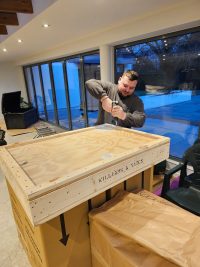
At Williams and Yates, every crate for a high-value or fragile item is built in-house by our own craftsmen, designed specifically around the dimensions, weight, fragility, and sensitivity of the individual piece. The design process begins with a condition survey of the item: any existing damage, fragility points, or sensitivity to pressure is recorded and the crate specification is built around protecting against those specific risks during the journey.
The construction standards we apply reflect the requirements of museum-quality transit. Timber is ISPM15-certified to satisfy international phytosanitary regulations for wood packaging material, which is a mandatory requirement for all wooden crates entering the United States. Internal packing materials are acid-free throughout: Tyvek, glassine, and acid-free tissue are used to wrap all contact surfaces, preventing any risk of chemical reaction between packing material and the surface of the work. Items are elevated within the crate to avoid floor contact, and the design includes expansion gaps to accommodate any minor movement of the crate walls during transit without transmitting force to the item inside.
For particularly sensitive works, including those on panel, works with lifting or flaking paint, or pieces with gilded surfaces, additional conservation-standard precautions are incorporated into the crating specification in consultation with a conservator. This is not a standard service offered by general removal companies: it is a core part of what Williams and Yates delivers for every significant item in a collection.
Documentation: What Every Piece in Your Collection Needs
Thorough documentation is the foundation of a smooth fine art import into the United States. It supports the customs classification, substantiates the duty-free claims, provides the basis for insurance settlement in the event of damage or loss, and establishes the legal status of every item in the collection. The documentation package for a significant relocation of fine art and antiques should be assembled during the pre-move assessment process, well before packing begins.
The core documentation for each significant item includes the following.
- A commercial or pro forma invoice stating the artist’s name, title of the work, medium, dimensions, country of origin, and the declared value for customs purposes.
- Provenance records establishing the chain of ownership from creation or first acquisition to the present day. For older works and antiques, these records are also the basis for establishing age and origin for duty exemption purposes.
- An independent professional appraisal providing the current market value of each significant piece. This is the figure used for insurance coverage and is distinct from the purchase price, which may be considerably different for older acquisitions.
- A condition report with high-resolution photography documenting the state of each item before packing. This is the reference against which any transit damage is assessed, and a detailed pre-move condition report is essential for any meaningful insurance claim.
- An Antique Declaration for items claimed as over 100 years old, certifying their age and the basis on which that age is established.
- Arts Council England export licence where required. UK law requires an export licence for items over 50 years old that exceed certain value thresholds. The thresholds vary by category. Williams and Yates will advise on whether an export licence is required for any item in your collection and manage the application process.
- CITES permits for any item containing materials from protected species, as detailed in the preceding section.
Williams and Yates prepares a consolidated customs inventory covering every item in the shipment, cross-referenced to the supporting documentation for each piece. This inventory is the document your US customs broker works from, and its accuracy and completeness directly determines how smoothly clearance proceeds.
Wine Collections and Other Specialist Categories
Wine Collections
Relocating a wine collection to the United States introduces a regulatory framework that is entirely separate from the standard fine art and household goods import process. Federal alcohol import duties apply on a per-bottle basis: still wine below 16% ABV attracts a federal excise tax of $1.07 per wine gallon, equivalent to approximately $0.21 per standard 750ml bottle. Sparkling wine is taxed at $3.40 per wine gallon. In addition to federal excise tax, the current 10% universal import tariff applies to most wine imports. State alcohol control laws introduce a further layer of complexity: some states restrict or prohibit direct wine shipments, and the regulatory requirements vary significantly by destination state.
For a meaningful wine collection, the regulatory planning should begin early and in coordination with a specialist wine logistics company. Williams and Yates coordinates wine collection logistics as part of the broader household relocation, working alongside wine specialists whose knowledge of US state alcohol regulations and temperature-controlled shipping ensures that your cellar arrives in the same condition in which it left.
Classic and High-Value Vehicles
Shipping a vehicle from the UK to the United States is subject to safety and emissions standards enforced by the Department of Transportation and the Environmental Protection Agency. In general, only vehicles originally manufactured to US standards can be imported without significant modification. The process for non-US-specification vehicles is complex, the costs of compliance modification are substantial, and the timeline is uncertain. Most clients who explore vehicle shipping conclude that selling in the UK and purchasing in the United States is the more practical and cost-effective approach. Williams and Yates will advise on the practicalities for any specific vehicle and can manage the logistics for clients who determine that shipping is the right decision.
Musical Instruments
High-value musical instruments, particularly those containing ivory keys, tortoiseshell elements, or protected timber components such as Brazilian rosewood fingerboards, are subject to CITES restrictions on the same basis as antiques and art. Instruments in transit require specific CITES documentation and must enter through designated ports. Professional musicians and serious collectors should raise this with Williams and Yates at the earliest possible stage, as the permit process and the routing implications of CITES-designated port requirements may influence the overall shipping plan.
Insurance for High-Value Relocation Shipments
Fine art insurance for transatlantic transit is a specialist category that operates differently from standard contents or goods-in-transit coverage. The appropriate policy for a significant collection is nail-to-nail cover: insurance that attaches from the moment an item leaves your UK property and remains in force until it is installed and accepted at your US destination. This is the coverage standard used by museums and major collectors, and it is the minimum appropriate standard for any collection of meaningful value.
Cover should be arranged on an agreed-value basis, using the current independent appraisal for each piece rather than purchase price or replacement cost. The premium for nail-to-nail fine art transit insurance typically runs at 0.5% to 2% of declared value, depending on the nature of the items, the shipping conditions, and the insurer. Williams and Yates will advise on appropriate coverage levels as part of the pre-move assessment, and your move coordinator will ensure that the insurance documentation is in order before any item leaves your property.
How Williams and Yates Manages High-Value Relocations
For those relocating to the United States with fine art, antiques, wine collections, or other high-value possessions, Williams and Yates offers a level of specialist capability that goes well beyond what any general removal company can provide. Our dedicated move coordinators, our in-house custom crating workshop, our climate-controlled shipping specifications, and our expertise in US import regulations and CITES compliance are all brought to bear on every complex relocation we manage.
The process begins with a thorough pre-move assessment of your property and collection. Our team will survey every item of significance, identify those requiring specialist handling, document condition comprehensively, identify any CITES-relevant materials, and advise on documentation requirements for each piece. From that assessment, we build a detailed logistics plan, a customs documentation package, and a crating specification for every item that warrants one.
Our partnership with the British Institute of Interior Design (BIID) reflects the design community’s trust in our handling of the high-value and irreplaceable items that define the interiors their clients commission. For household managers, PAs, and interior designers overseeing relocations on behalf of principals, Williams and Yates provides the level of specialist expertise and accountability that those principals rightly expect.
Your collection has been assembled over years or decades. The journey from your UK property to your US home takes weeks. The difference between a relocation managed by a specialist and one managed by a general removal company is the difference between your collection arriving as it left and the alternative. We take that responsibility seriously.
To arrange a pre-move assessment and begin the specialist planning process, please contact our team. For complex collections, we recommend making contact twelve months or more before your intended move date.


To book or ask us a question, call us on 0208 081 0188 or get in touch.